Cover Letter Tips: How to Write One That Stands Out
 Gowri Shanker·Nov 16, 2026
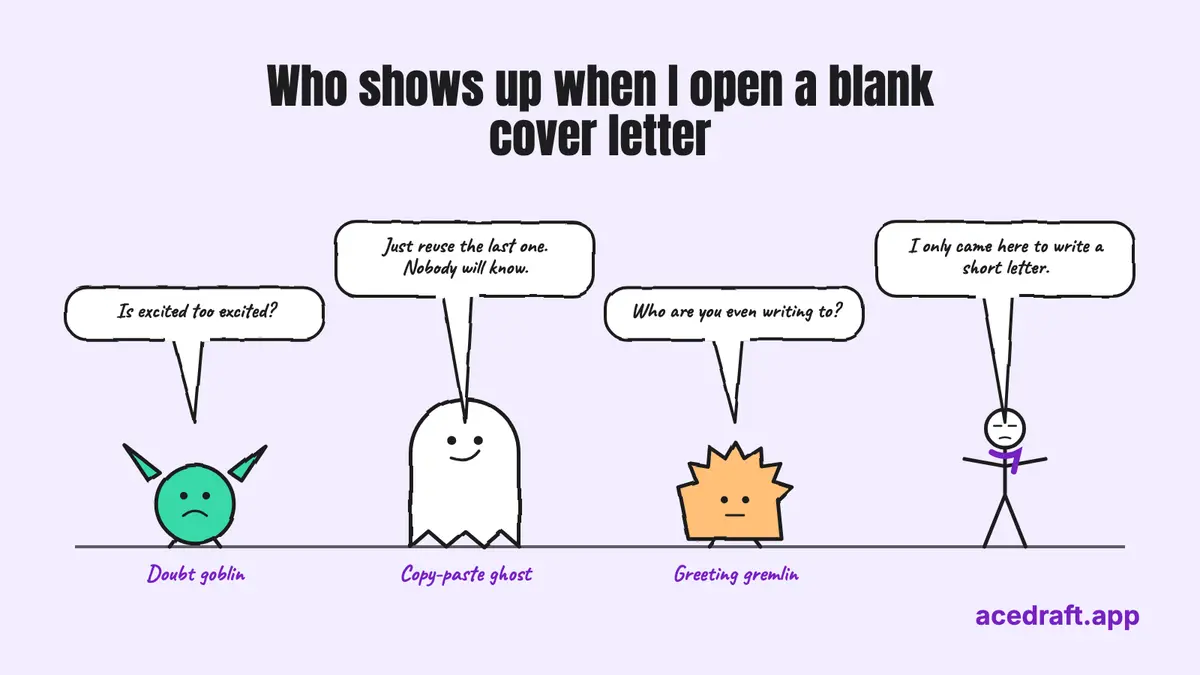
A cover letter is a short letter, usually one page, that goes with your resume and tells one employer why you want this particular job and why you fit it. The cover letter tips that most of the five career services I read share fit in one breath: tailor it to the job, keep it to about a page, write to a named person if you can, and don't retell your resume.
Two concessions before the tips. First, I build AceDraft, a resume tool, and AceDraft has no cover-letter tool. Nothing in this post leads to a product that writes your letter, because I haven't built one.
Second, and this one matters more. I went looking for a survey or study on whether employers actually read cover letters, and I found no measured evidence either way. So everything below is advice from four US university career centres and the UK National Careers Service. It's what career advisers recommend, not measured outcomes. For four of the five, the page shows no date; I read it on 16 November 2026. The James Madison University page shows 9 November 2026, without saying whether that's a publish or an update date.
Key takeaways
- All five career services I read say to tailor the letter to the job (Portland State, Northern Illinois, James Madison, CSU San Marcos and the UK National Careers Service, read 2026).
- The four US career centres all say one page at most. CSU San Marcos goes shorter and suggests half a page (read 2026).
- Four of the five say to write to a named person when you can (all except CSU San Marcos in the lines I recorded, read 2026).
- They disagree on whether you always need one: the National Careers Service says always include one with a CV, while James Madison says it may be required or optional (2026).
- Limitation: I found no measured evidence on whether employers read cover letters. This is career-centre advice, not results.
What's in this guide
- How do you write a cover letter that stands out?
- Do cover letters matter in 2026?
- What cover letter tips do five career services agree on?
- What should the first line of a cover letter say?
- How do I show I've read the job description without repeating my resume?
- How long should a cover letter be in the US and UK?
- How do I explain a career gap or a career change in a cover letter?
- Does an ATS read my cover letter?
- What should I never put in a cover letter?
- What haven't I tested?
How do you write a cover letter that stands out?
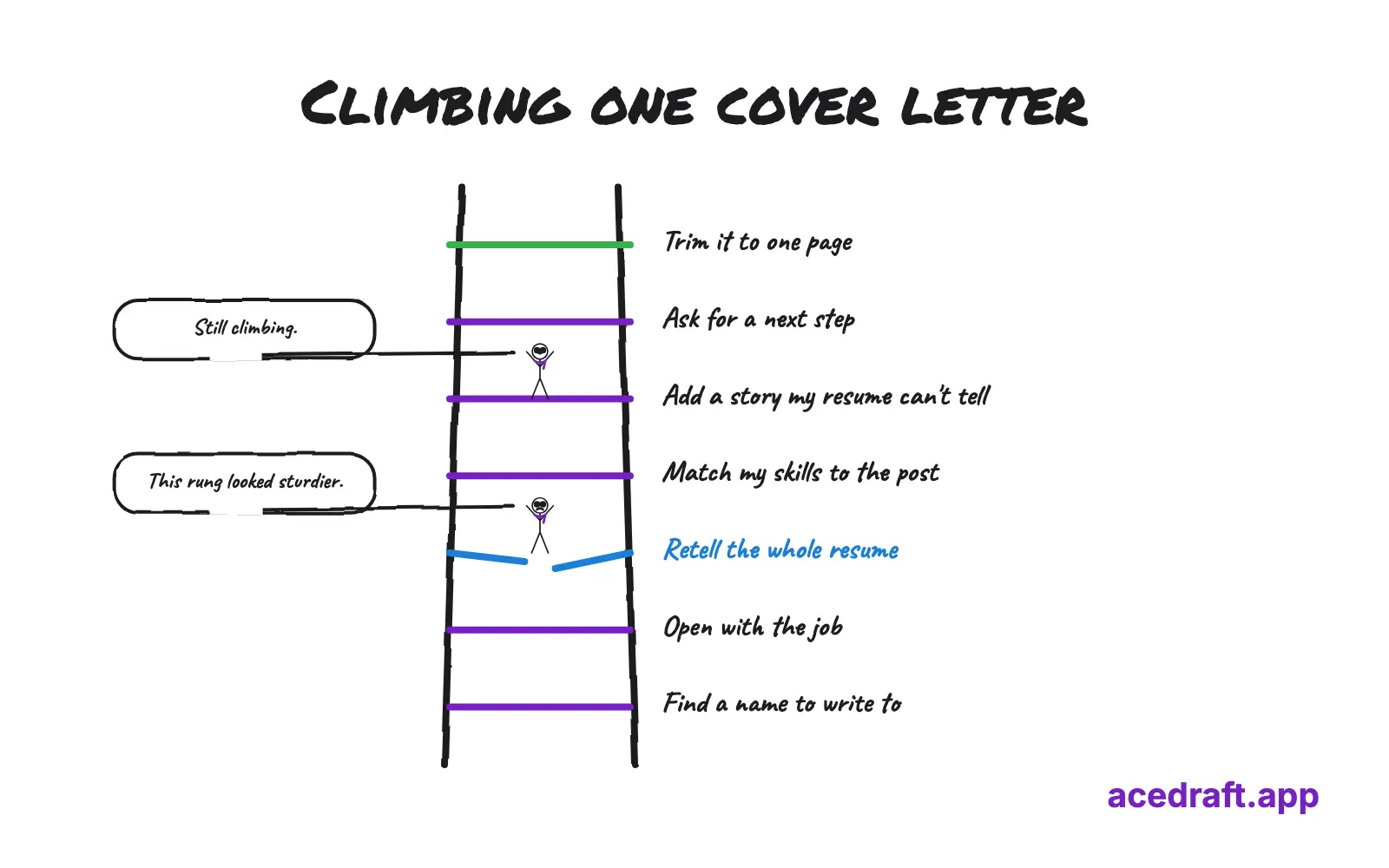
You write a cover letter that stands out by making it plainly about one job: say who you are and why you're writing, connect a few of your real skills to what the posting asks for, and finish inside one page. That's the short version of what the five career services say.
The order below follows James Madison University's advice for the opening paragraph: "Identify who you are, why you are writing, and where you learned of the opening." Then it builds from there.
- Find a name to write to. Portland State, Northern Illinois, James Madison and the National Careers Service all say to address a person if you can.
- Open with the job. Say which role, where you saw it, and the main reason you think you fit.
- Match your skills to the posting in the middle. The National Careers Service puts it simply: "Highlight the skills and experience you have that match what the employer is looking for."
- Add something the resume can't show. The story behind one result, or why this employer and not the one down the road.
- Close with what you'd like to happen next. This step is my own habit. None of the lines I recorded from the five pages covers closings.
- Cut until it fits on one page, then save it with a sensible file name. Portland State says: "Make sure all of the file names include your name and the position title."
I'd write the letter after the resume, never before. The resume is the evidence. The letter is the argument for why that evidence matters to this one employer, and you can't argue well from evidence you haven't sorted yet.
If your resume isn't matched to the posting yet, start there. I wrote up how to tailor a resume to a job description without rewriting it, and the letter gets much easier once that's done.
Do cover letters matter in 2026?
I can't give you a number for this one. I looked for a survey or study on how many employers read cover letters and found nothing I could trace, though all five career services I read still tell you how to write one.
I'd rather leave a gap than fill it with a figure I can't check.
What the sources do say is about whether to send one, and they don't fully agree. The UK National Careers Service is firm: "You should always include a cover letter when you apply for a job using a CV." James Madison University is more relaxed: "When submitting materials to prospective employers, you may be required or given the option to include a cover letter." Northern Illinois University calls the letter "a key part of your job, internship or graduate school application."
My reading, and it's only my reading: those two positions are closer than they look. The UK page is talking to someone sending a CV, where a covering letter (the usual UK name) is the expected companion. The JMU page is describing what application forms do, and some forms mark the letter as optional.
If the form has a place for a letter, I'd write one. An optional box is a free chance to say something your resume can't, and I'd rather use it than leave it empty. I can't prove it changes anything, and nobody I read could either.
What cover letter tips do five career services agree on?
All five career services agree on one tip, tailoring the letter to the job. Four of them also say one page at most and a named person when you can, and three warn against repeating your resume word for word. The chart below shows which page says what, with one chip per page, quoted from each page as I read it on 16 November 2026. The five are Portland State University, Northern Illinois University, James Madison University, California State University San Marcos and the UK government's National Careers Service.
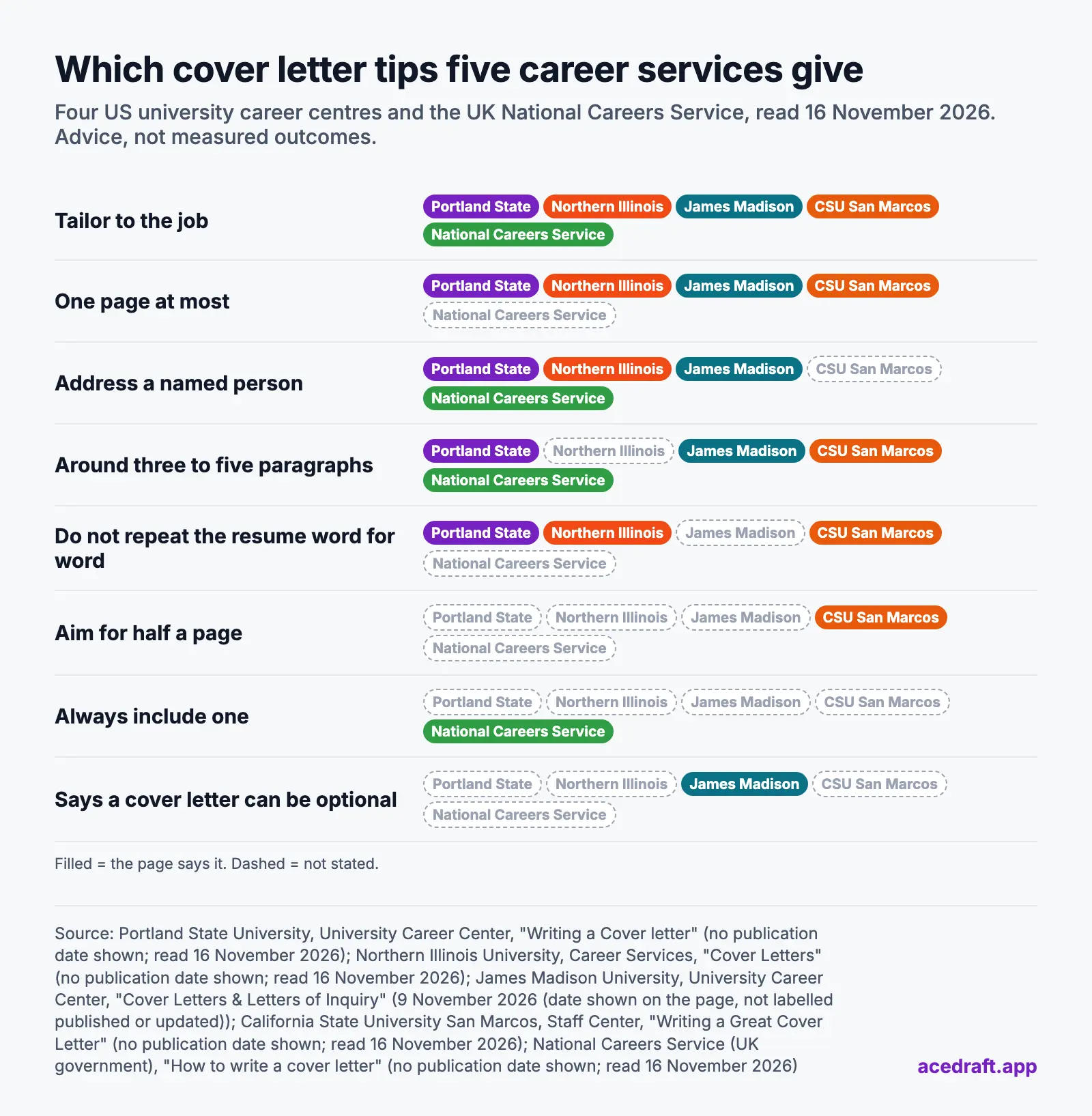
| Advice | Portland State | Northern Illinois | James Madison | CSU San Marcos | National Careers Service (UK) |
| Tailor to the job | Yes | Yes | Yes | Yes | Yes |
| One page at most | Yes | Yes | Yes | Yes | Not stated |
| Address a named person | Yes | Yes | Yes | Not stated | Yes |
| Around three to five paragraphs | Yes | Not stated | Yes | Yes | Yes |
| Do not repeat the resume word for word | Yes | Yes | Not stated | Yes | Not stated |
| Aim for half a page | Not stated | Not stated | Not stated | Yes | Not stated |
| Always include one | Not stated | Not stated | Not stated | Not stated | Yes |
| Says a cover letter can be optional | Not stated | Not stated | Yes | Not stated | Not stated |
Sources: Portland State University, University Career Center, "Writing a Cover letter" (no publication date shown; read 16 November 2026); Northern Illinois University, Career Services, "Cover Letters" (no publication date shown; read 16 November 2026); James Madison University, University Career Center, "Cover Letters & Letters of Inquiry" (9 November 2026 (date shown on the page, not labelled published or updated)); California State University San Marcos, Staff Center, "Writing a Great Cover Letter" (no publication date shown; read 16 November 2026); National Careers Service (UK government), "How to write a cover letter" (no publication date shown; read 16 November 2026).
Tailoring is the only tip all five state outright. Northern Illinois is the bluntest about it: "Using the same cover letter for every application is a common mistake, and employers can tell." I like that line.
Where the five differ, they differ in three places:
- Length. All four US pages cap the letter at one page. CSU San Marcos then goes further: "Aim for half a page or about three short paragraphs." Portland State and James Madison talk about three to five paragraphs; Northern Illinois only gives the one-page cap.
- Whether you need one at all. The National Careers Service says always include one when you apply with a CV. James Madison says you may be required, or given the option.
- The greeting when you can't find a name. The National Careers Service says "If you still cannot find a name, you can start your letter with 'Dear Sir or Madam'." James Madison calls "Dear Sir/Madam" "very impersonal" and says it "indicates a lack of real interest in the organization."
One caution about that chart itself. These are five pages from universities and a government service, all written to help people apply. Their agreement shows a shared view among career advisers. It doesn't show what hiring managers actually do, because none of them measured that.
What should the first line of a cover letter say?
The first line of a cover letter, after the greeting, should name the job you're applying for and give the reader a reason to keep going. Northern Illinois puts the goal as: "Begin with a strong opening that draws the reader in."
Here's where people get stuck, and I'm one of them. The greeting is easy to obsess over, and the classic "To Whom It May Concern" doesn't appear on any of the five pages I read. The pages that cover greetings push for a real name instead. The National Careers Service says: "It's important to try to address your cover letter to someone by name." Portland State adds "if at all possible", which I read as permission to stop searching at some point.
So spend your effort finding the name, then move on to the line that does the work. If the posting names a hiring manager, use that name. If it doesn't, the company's own team page sometimes does. If you truly can't find one, that's the point where the sources split, as the chart below shows.
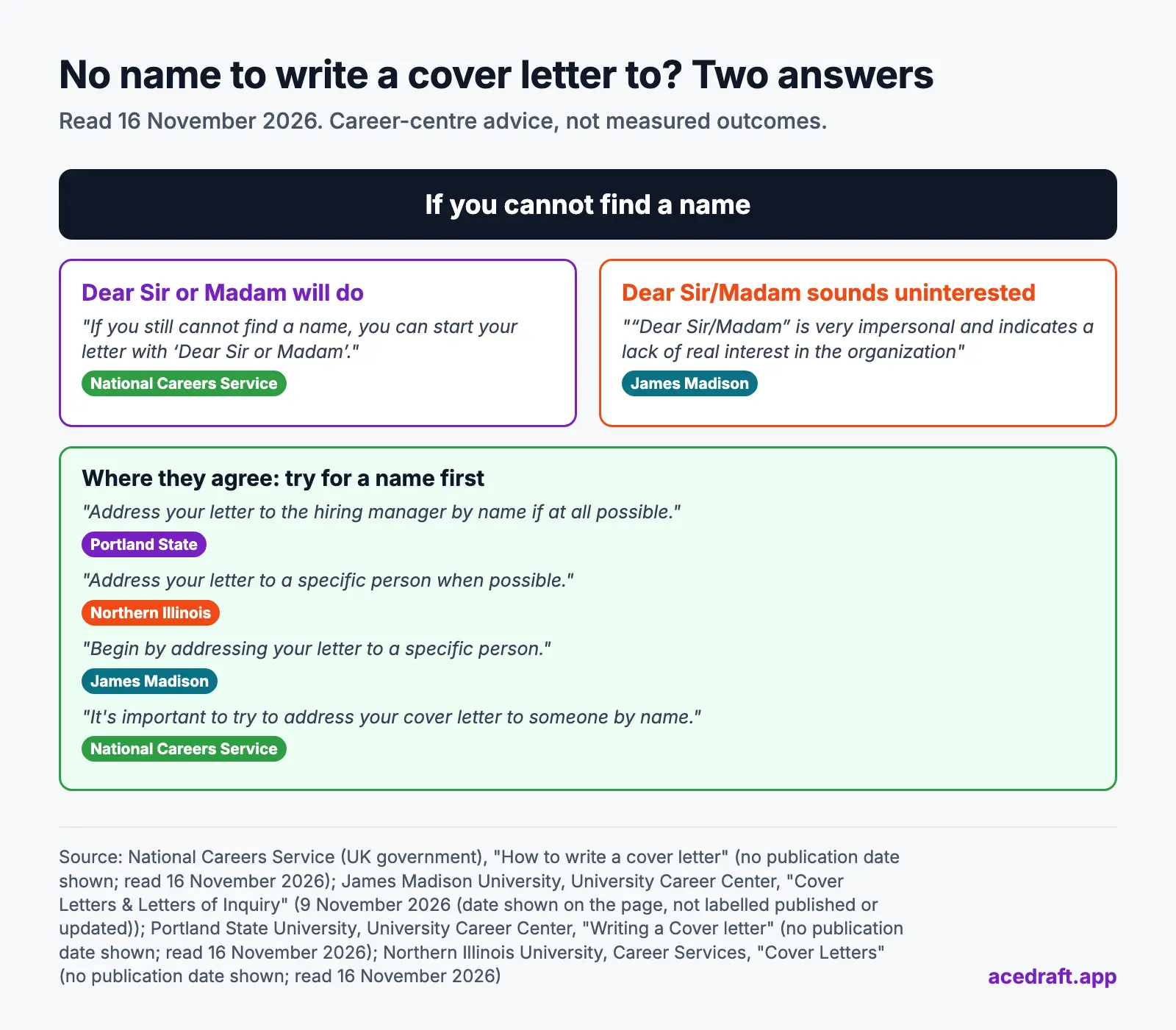
| Point | What the source says | Source |
| Dear Sir or Madam will do | "If you still cannot find a name, you can start your letter with ‘Dear Sir or Madam’." | National Careers Service (UK government), "How to write a cover letter" |
| Dear Sir/Madam sounds uninterested | "“Dear Sir/Madam” is very impersonal and indicates a lack of real interest in the organization" | James Madison University, University Career Center, "Cover Letters & Letters of Inquiry" |
| Where they agree: try for a name first | "Address your letter to the hiring manager by name if at all possible." | Portland State University, University Career Center, "Writing a Cover letter" |
| Where they agree: try for a name first | "Address your letter to a specific person when possible." | Northern Illinois University, Career Services, "Cover Letters" |
| Where they agree: try for a name first | "Begin by addressing your letter to a specific person." | James Madison University, University Career Center, "Cover Letters & Letters of Inquiry" |
| Where they agree: try for a name first | "It's important to try to address your cover letter to someone by name." | National Careers Service (UK government), "How to write a cover letter" |
Sources: National Careers Service (UK government), "How to write a cover letter" (no publication date shown; read 16 November 2026); James Madison University, University Career Center, "Cover Letters & Letters of Inquiry" (9 November 2026 (date shown on the page, not labelled published or updated)); Portland State University, University Career Center, "Writing a Cover letter" (no publication date shown; read 16 November 2026); Northern Illinois University, Career Services, "Cover Letters" (no publication date shown; read 16 November 2026).
Here's an example opening I wrote for this post, for a made-up receptionist job. It isn't from a real letter:
I'm applying for the front desk receptionist role on your website because the posting asks for someone who can keep a busy reception calm, and that's the part of my last job I'd most like to do again.
Notice what it skips. It doesn't start with "I am writing to apply for the position of", which tells the reader nothing they didn't know when they opened the letter. It names the job and picks one thing from the posting. Then it makes a promise the next paragraph has to keep.
That last part is the test I'd use on any first line. If the second paragraph doesn't back up the first, the opening was a slogan.
How do I show I've read the job description without repeating my resume?
You show you've read the job description by naming one or two things the posting asks for and telling a short story your resume can't, about a time you did that thing. The resume lists what you did. The letter explains why it matters for this job.
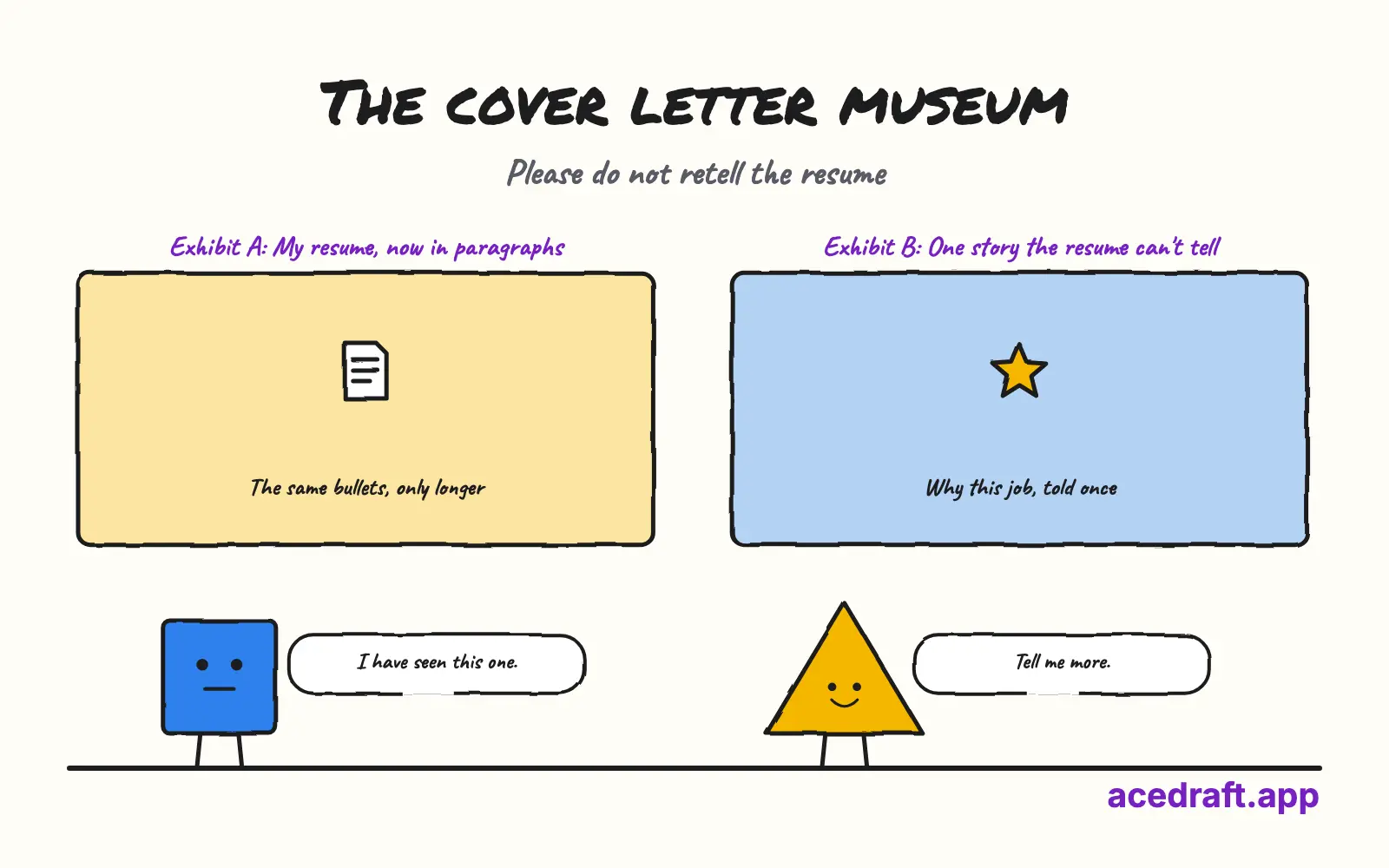
Three of the five sources warn against the left side of that drawing in almost the same words. Portland State: "It is not a reiteration of your resume." Northern Illinois: "Refer to key experiences from your resume but avoid repeating it word-for-word." CSU San Marcos lists, as a mistake, "Repeating your résumé bullet points word for word instead of expanding on your experience". James Madison frames the same idea from the other side: "Relate your qualifications and skills to the position or organization to which you are applying."
Here's the method I'd use. It's my own process, not one the sources lay out:
- Read the posting and mark the duties it repeats or lists first. Those are usually what the employer cares about most, though that's my assumption, not a rule anyone measured.
- Pick one or two of those you've genuinely done.
- For each one, write what your resume bullet leaves out: the situation, what made it hard, and why you'd handle it the same way at this job.
- Put the letter and the resume side by side. If a sentence is just a bullet with "I" stuck on the front, rewrite it or cut it.
One habit the museum doesn't show is opening with what I want. That one is my own pet peeve, not something a source says. A letter that starts with what you hope to get from the job is about you. A letter that starts with what the job needs is about them, and I'd rather read the second.
Using the posting's own words is the same skill you use on your resume. I covered that in how to find and use the right resume keywords. In a letter, the difference is that the words have to sit in sentences a person would say out loud.
How long should a cover letter be in the US and UK?
One page. All four US career centres I read cap it there, and the UK National Careers Service calls it "a short letter, usually 3 to 5 paragraphs long."
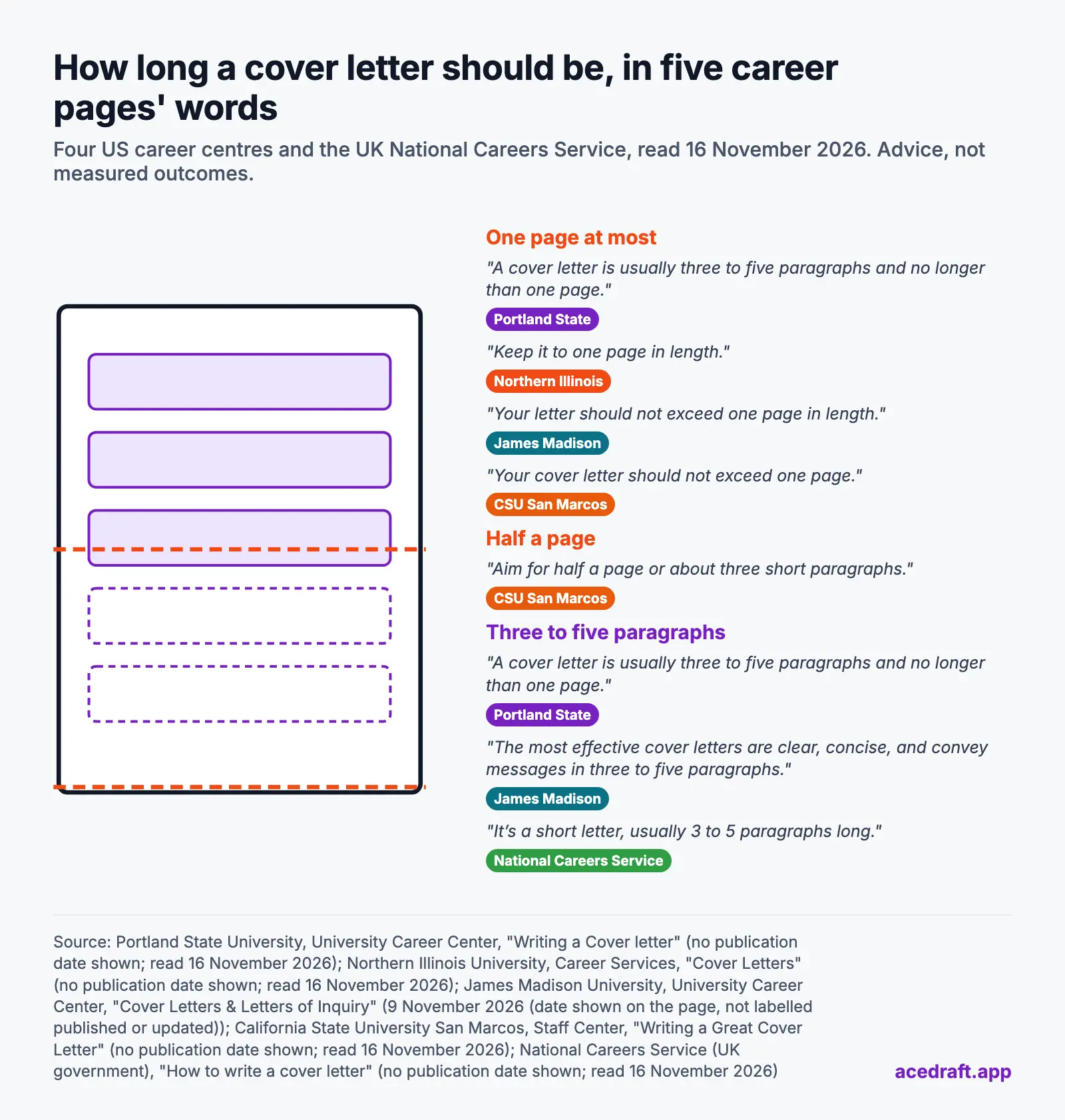
| Point | What the source says | Source |
| One page at most | "A cover letter is usually three to five paragraphs and no longer than one page." | Portland State University, University Career Center, "Writing a Cover letter" |
| One page at most | "Keep it to one page in length." | Northern Illinois University, Career Services, "Cover Letters" |
| One page at most | "Your letter should not exceed one page in length." | James Madison University, University Career Center, "Cover Letters & Letters of Inquiry" |
| One page at most | "Your cover letter should not exceed one page." | California State University San Marcos, Staff Center, "Writing a Great Cover Letter" |
| Half a page | "Aim for half a page or about three short paragraphs." | California State University San Marcos, Staff Center, "Writing a Great Cover Letter" |
| Three to five paragraphs | "A cover letter is usually three to five paragraphs and no longer than one page." | Portland State University, University Career Center, "Writing a Cover letter" |
| Three to five paragraphs | "The most effective cover letters are clear, concise, and convey messages in three to five paragraphs." | James Madison University, University Career Center, "Cover Letters & Letters of Inquiry" |
| Three to five paragraphs | "It’s a short letter, usually 3 to 5 paragraphs long." | National Careers Service (UK government), "How to write a cover letter" |
Sources: Portland State University, University Career Center, "Writing a Cover letter" (no publication date shown; read 16 November 2026); Northern Illinois University, Career Services, "Cover Letters" (no publication date shown; read 16 November 2026); James Madison University, University Career Center, "Cover Letters & Letters of Inquiry" (9 November 2026 (date shown on the page, not labelled published or updated)); California State University San Marcos, Staff Center, "Writing a Great Cover Letter" (no publication date shown; read 16 November 2026); National Careers Service (UK government), "How to write a cover letter" (no publication date shown; read 16 November 2026).
The detail varies a little. Portland State says a letter "is usually three to five paragraphs and no longer than one page." James Madison says the most effective ones "convey messages in three to five paragraphs" and should "not exceed one page in length." Northern Illinois says "Keep it to one page in length." CSU San Marcos is the shortest: no more than one page, and ideally half a page or about three short paragraphs.
If you want a cover letter format to hang that on, three to five paragraphs works out to an opening paragraph, one to three middle paragraphs about the job, and a short close. Add your greeting above and your sign-off below. That's the whole skeleton.
I didn't find an Indian source for this post, so I can't tell you whether advice in India differs. None of the pages I read suggests going past one page, so that's where I'd stop unless an employer asks for something else.
None of the five pages measured how far anyone reads a letter. What they agree on is the limit, and if you catch yourself shrinking the margins to squeeze under it, the letter is too long. The margins are fine.
How do I explain a career gap or a career change in a cover letter?
Keep it to one or two plain sentences: what happened, and what you bring now. Then get back to the job. Don't give it a whole paragraph unless the posting gives you a reason to.
I should be clear that this part is my own view. None of the lines I recorded from the five pages covers gaps or career changes, so I won't pretend the career services back me here.
For a gap, the letter is a good place for the short, honest version, because a resume can only show dates. Here's an example I wrote, for an imaginary bookkeeper: "I took eighteen months away from work to care for a family member, and during that time I kept the accounts for a local charity, so my bookkeeping is current." One sentence on what happened, one fact about now. I wrote more about this in how to explain a career gap on a resume honestly, then show proof.
A career change is where the letter does something a resume really can't. Take an imaginary teacher moving into training design. The resume shows a teacher's history. Only the letter can say why they want the move, and which parts of the old job carry over. Pick the one or two skills that travel best and tie each to something the new posting asks for. The resume side of a switch is in resume tips for switching fields.
What I'd avoid in both cases is apologising. A sentence that starts "Although I don't have direct experience..." puts the weakness on the page before you've given anyone a reason to look past it.
Does an ATS read my cover letter?
I don't know whether an applicant tracking system (ATS) reads your cover letter, and none of the five pages I read says how an ATS handles one, so I won't guess. I also haven't submitted a cover letter through any named employer's system for this post.
What the pages do say is practical and about the file. Portland State notes: "For resumes and cover letters, .pdf and .doc files are most common." It also wants your name and the position title in every file name. As a fallback, CSU San Marcos suggests you "Paste a short version" of the letter into the form's Additional Information box.
So my advice is to write the letter for a person. If software reads it too, plain paragraphs with no tables or text boxes are the most sensible thing I can think of for both readers.
The resume is the side I can help with. I built a free ATS scan that compares your resume PDF with one pasted job description and lists the keywords from that posting your resume uses and the ones it misses. It's AceDraft's own scoring, not any employer's ATS, and it doesn't read cover letters.
What should I never put in a cover letter?
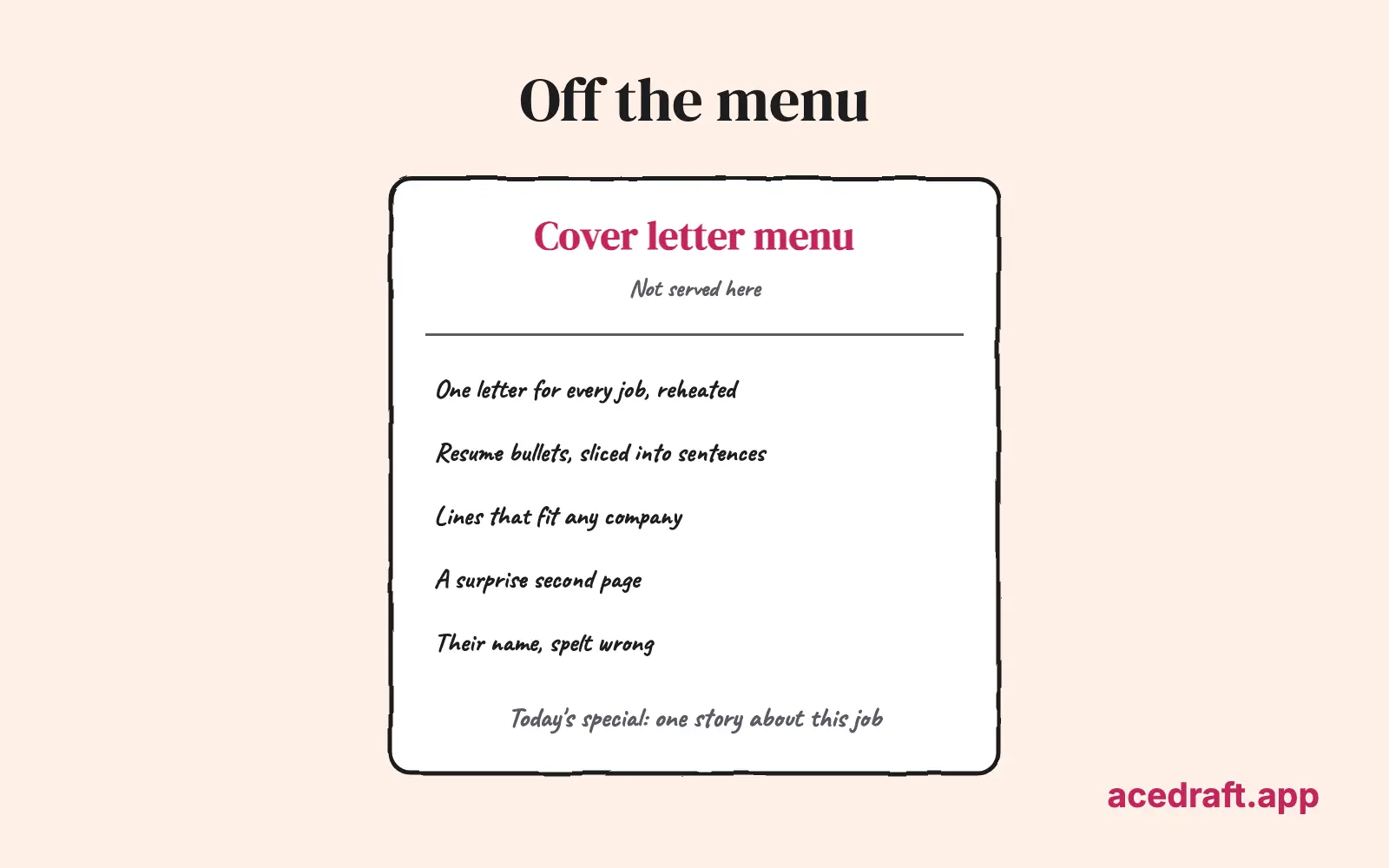
Two mistakes get named outright: generic lines that could go to any employer, and resume bullets copied word for word.
- Generic statements. CSU San Marcos lists "Using generic statements that could apply to any position" as a mistake.
- One letter for every job. Northern Illinois calls it a common mistake.
- Your resume, retold. Portland State, Northern Illinois and CSU San Marcos all warn against it.
- A second page. All four US pages say one page at most.
- The wrong name, or the right name spelt wrong. This one is mine. If the sources all push you to find a name, getting it wrong undoes the effort.
- Anything you couldn't talk about in an interview. Also mine. A letter makes claims, and someone may ask you about every one.
I'd add a smaller one: don't stuff the letter with the posting's exact phrases until it reads like the posting. Using the employer's words for the things you've actually done is good. Pasting their list back at them is the cover letter version of repeating your resume.
What haven't I tested?
I haven't tested whether any of the advice in this post changes what happens to an application, and none of the five sources measured that either. Here's what that leaves out:
- I found no survey or study on whether employers read cover letters, so the post has no figure on it. If you know of a measured, dated source, I'd like to read it.
- I haven't checked how any applicant tracking system stores, searches or skips a cover letter.
- My five sources are four US university career centres and one UK government service. I have no Indian source and no source written by employers or recruiters themselves.
- Pages change. I recorded these lines on 16 November 2026, and four of the five pages carry no date, so I can't tell when their advice was last reviewed.
Write one if the form has a place for it, the posting asks for one, or you're applying with a CV in the UK. Keep it to a page, and make every paragraph about this job.
Skip it if the posting tells you not to send one. In every other case I'd write it, and I'd write it after the resume is done.
Sources
- Portland State University, University Career Center, "Writing a Cover letter". The page shows no date; I read it on 16 November 2026.
- Northern Illinois University, Career Services, "Cover Letters". The page shows no date; I read it on 16 November 2026.
- James Madison University, University Career Center, "Cover Letters & Letters of Inquiry". The page shows 9 November 2026 (not labelled as published or updated); I read it on 16 November 2026.
- California State University San Marcos, Staff Center, "Writing a Great Cover Letter". The page shows no date; I read it on 16 November 2026.
- National Careers Service (UK government), "How to write a cover letter". The page shows no date; I read it on 16 November 2026.
Frequently asked questions
Do cover letters matter?
How do you write a cover letter?
How long should a cover letter be?
Who do I address a cover letter to if I can't find a name?
Should I send a cover letter if it says optional?
Can I use the same cover letter for every job?
What file format should a cover letter be in?
Does AceDraft write cover letters?
Is the AceDraft resume export free?
Share this post
Know someone job-hunting? Send it their way.
Comments
No comments yet. Be the first to comment.