Networking Email: What to Write, With Example Templates
 Gowri Shanker·Nov 16, 2026
A networking email is a short email to someone who works in a field, team or company you're interested in, asking for their advice, a brief conversation or, once they know you, a referral. It's often the first contact you've ever had with them, so in a few lines it has to say who you are and what you're asking for. This guide covers the subject line, the length, the follow-up and attachments, and gives you six example emails to copy.
Two things before the examples. First, I build AceDraft, a resume builder, and it has no email, outreach or cover-letter tool. Nothing in this post was written by software of mine. Every example email here I wrote by hand for this post, and I haven't sent any of them, so I can't tell you which one gets replies.
Second, what I do have is six career pages I read on 16 November 2026: five from US colleges and universities, plus Job-Hunt.org. None of them shows a publication date. None gives a word limit for the email, and none has any data on reply rates. Where they're silent, the advice is mine, and I'll label it each time.
Key takeaways
- Say how you found the person. Dartmouth's Center for Career Design: "Always include how you came across someone’s name" (read 2026).
- Ask for a short conversation and leave the job out of it. Loyola Marymount and Thomas Jefferson University both word the ask as 20 minutes, and Loyola Marymount and Job-Hunt.org both say not to ask for a job (read 2026).
- The follow-up wait differs by source: a week (Jefferson), 5 to 7 days (Dartmouth), at least 2 or 3 business days (Job-Hunt.org), all read 2026.
- Limitation: none of the six pages gives a word count or any reply-rate figure, and the example emails in this post are mine and unsent.
What's in this guide
- What makes a networking email different from a LinkedIn message?
- What should a networking email subject line say?
- How long should a networking email be?
- What does a networking email template look like when I'm asking for a referral?
- How do I email an alum or a stranger with no mutual contact?
- How do I write the follow-up email when nobody replies?
- Should I attach my resume to a networking email?
- What haven't I tested?
What makes a networking email different from a LinkedIn message?
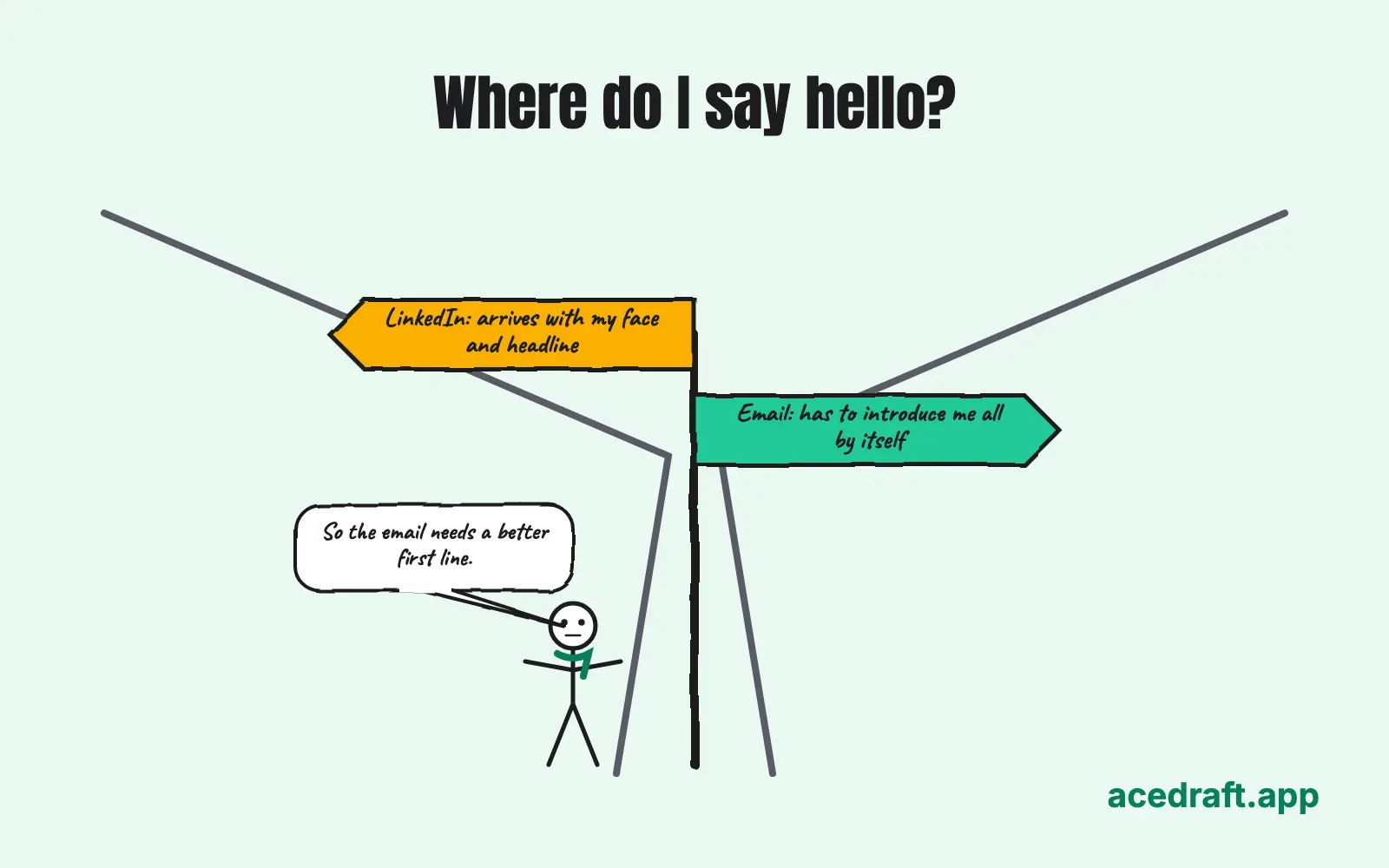
An email has to introduce you on its own. A LinkedIn message shows up with your name, photo and headline beside it (as of November 2026). An email arrives with your name and a subject line, next to everything else in that inbox.
That changes the job of the first two sentences. In an email, they carry the introduction a profile would otherwise carry. Thomas Jefferson University's Center for Career Success puts the tone plainly: "The email should be written formally (similar to a cover letter for a traditional interview, but shorter)."
In my reading, formal there just means full sentences, a proper greeting, your full name at the bottom, and no abbreviations you'd only use in a chat window.
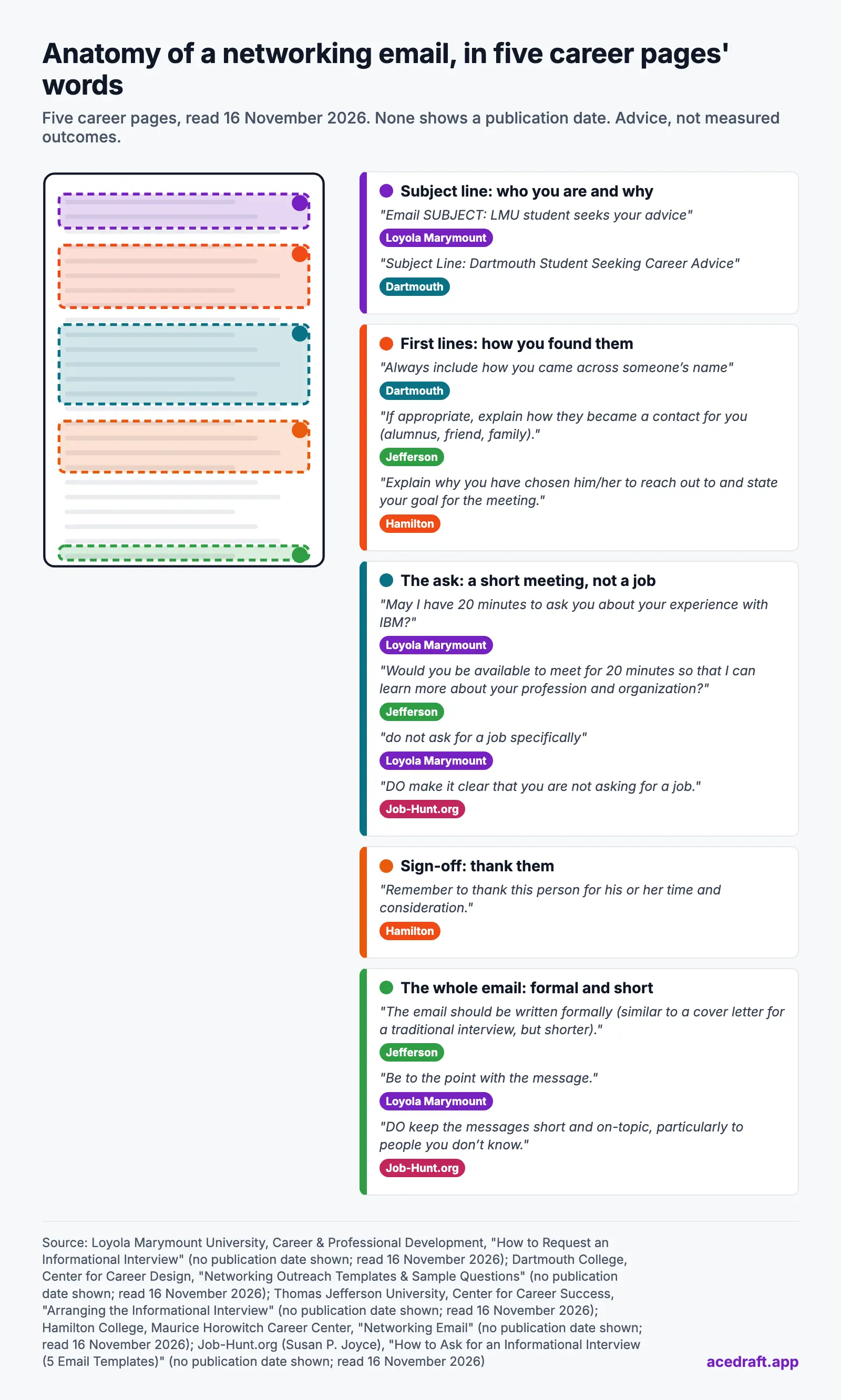
The marked-up email below shows which of five career pages gives which piece of advice about each part of the email, quoted from each page as I read it on 16 November 2026.
| Point | What the source says | Source |
| Subject line: who you are and why | "Email SUBJECT: LMU student seeks your advice" | Loyola Marymount University, Career & Professional Development, "How to Request an Informational Interview" |
| Subject line: who you are and why | "Subject Line: Dartmouth Student Seeking Career Advice" | Dartmouth College, Center for Career Design, "Networking Outreach Templates & Sample Questions" |
| First lines: how you found them | "Always include how you came across someone’s name" | Dartmouth College, Center for Career Design, "Networking Outreach Templates & Sample Questions" |
| First lines: how you found them | "If appropriate, explain how they became a contact for you (alumnus, friend, family)." | Thomas Jefferson University, Center for Career Success, "Arranging the Informational Interview" |
| First lines: how you found them | "Explain why you have chosen him/her to reach out to and state your goal for the meeting." | Hamilton College, Maurice Horowitch Career Center, "Networking Email" |
| The ask: a short meeting, not a job | "May I have 20 minutes to ask you about your experience with IBM?" | Loyola Marymount University, Career & Professional Development, "How to Request an Informational Interview" |
| The ask: a short meeting, not a job | "Would you be available to meet for 20 minutes so that I can learn more about your profession and organization?" | Thomas Jefferson University, Center for Career Success, "Arranging the Informational Interview" |
| The ask: a short meeting, not a job | "do not ask for a job specifically" | Loyola Marymount University, Career & Professional Development, "How to Request an Informational Interview" |
| The ask: a short meeting, not a job | "DO make it clear that you are not asking for a job." | Job-Hunt.org (Susan P. Joyce), "How to Ask for an Informational Interview (5 Email Templates)" |
| Sign-off: thank them | "Remember to thank this person for his or her time and consideration." | Hamilton College, Maurice Horowitch Career Center, "Networking Email" |
| The whole email: formal and short | "The email should be written formally (similar to a cover letter for a traditional interview, but shorter)." | Thomas Jefferson University, Center for Career Success, "Arranging the Informational Interview" |
| The whole email: formal and short | "Be to the point with the message." | Loyola Marymount University, Career & Professional Development, "How to Request an Informational Interview" |
| The whole email: formal and short | "DO keep the messages short and on-topic, particularly to people you don’t know." | Job-Hunt.org (Susan P. Joyce), "How to Ask for an Informational Interview (5 Email Templates)" |
Sources: Loyola Marymount University, Career & Professional Development, "How to Request an Informational Interview" (no publication date shown; read 16 November 2026); Dartmouth College, Center for Career Design, "Networking Outreach Templates & Sample Questions" (no publication date shown; read 16 November 2026); Thomas Jefferson University, Center for Career Success, "Arranging the Informational Interview" (no publication date shown; read 16 November 2026); Hamilton College, Maurice Horowitch Career Center, "Networking Email" (no publication date shown; read 16 November 2026); Job-Hunt.org (Susan P. Joyce), "How to Ask for an Informational Interview (5 Email Templates)" (no publication date shown; read 16 November 2026).
If a page isn't quoted next to a part of the email, the lines I recorded from it don't cover that part. Hamilton College's page, for example, might well cover follow-up timing somewhere I didn't record.
I read a sixth page, from Excelsior University's Online Writing Lab. I left it out of the picture because I recorded only three lines from it, too few to compare fairly. All three come up below, in the subject-line and length sections.
Where the pages agree, the pattern is clear. Say how you found the person. Ask for a meeting, and Loyola Marymount and Jefferson both name 20 minutes. Keep the email short. Thank them. Where they disagree is the follow-up wait, which I come back to below.
One caution about these pages. These are career advisers writing for their own students and alumni. Their agreement tells you what career advisers recommend. It doesn't tell you what gets a reply, because none of them measured that.
Two things this post won't repeat. If you're still working out who to contact at all, I covered that, and the general shape of a first message, in how to network: building a professional network from zero. And since a curious reader may look you up after your email, it's worth checking your profile says what you'd want them to see. LinkedIn headline examples and how to write yours covers that part.
What should a networking email subject line say?
Who you are and why you're writing, clearly enough that the person knows what the email is before they open it.
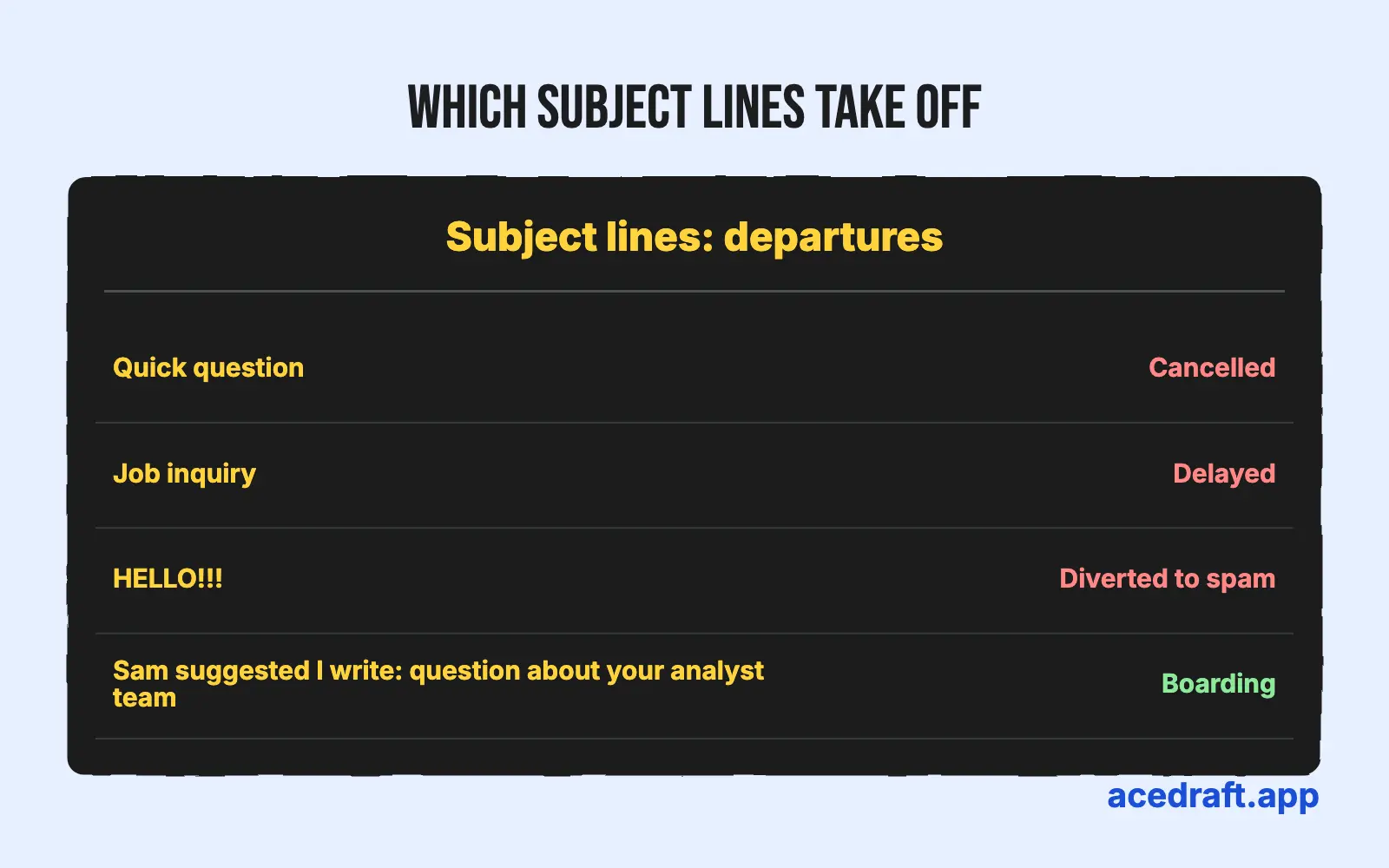
The shape of the line that's boarding is the part I'd copy: a connection, then a topic.
The career pages show the same idea through their own samples. Loyola Marymount's page gives "Email SUBJECT: LMU student seeks your advice". Dartmouth's gives "Subject Line: Dartmouth Student Seeking Career Advice". Both lead with the one thing the reader shares with the writer, which is the school.
Excelsior University's Online Writing Lab says to "include an interesting subject line in your email, something that has more detail than “introduction” or “interview request.”" It also gives a line for when someone pointed you to the person: "Jose Vasquez recommended I reach out to you."
Those two university samples are written for current students. If you graduated years ago, or never went to that school, lead with whatever connection you really have. Here are subject lines I wrote for this post, not taken from any source and not tested:
- A mutual contact: [Name] suggested I write: question about [team or role]
- Same university: [University] alum asking about [role] at [Company]
- Their work: Your talk on [topic]: one question from a [your role]
- A referral ask: Referral question about the [job title] role at [Company]
- A follow-up: leave the subject alone and reply in the same thread, so it reads Re: [original subject]
And three I'd avoid. "Quick question" says nothing. "Job inquiry" turns an advice request into an application before they've read a word. Anything in capitals reads like a sales email.
A side note on why the advice for this is so thin. When I checked the US search results for "networking email" on 16 November 2026, most of the subject-line pages in them came from email-marketing companies, plus a Vault page whose snippet was dated 2015. One of the marketing pages promises to boost opens, which is a goal for people selling things. Yours is a reply from one specific person, which is a different problem.
How long should a networking email be?
Short enough to read in one go on a phone. None of the six pages gives a word count, so the number I use, about 150 words or fewer for the body, is my own rule and nothing more.
What the pages do say all points the same way. Loyola Marymount: "Be to the point with the message." Job-Hunt.org: "DO keep the messages short and on-topic, particularly to people you don’t know." And Jefferson, again, says it should be like a cover letter "but shorter".
The reason I like a number at all is that "short" is easy to agree with and hard to stick to. Every draft I write grows a sentence of background that nobody asked for. A rough limit gives me permission to cut it.
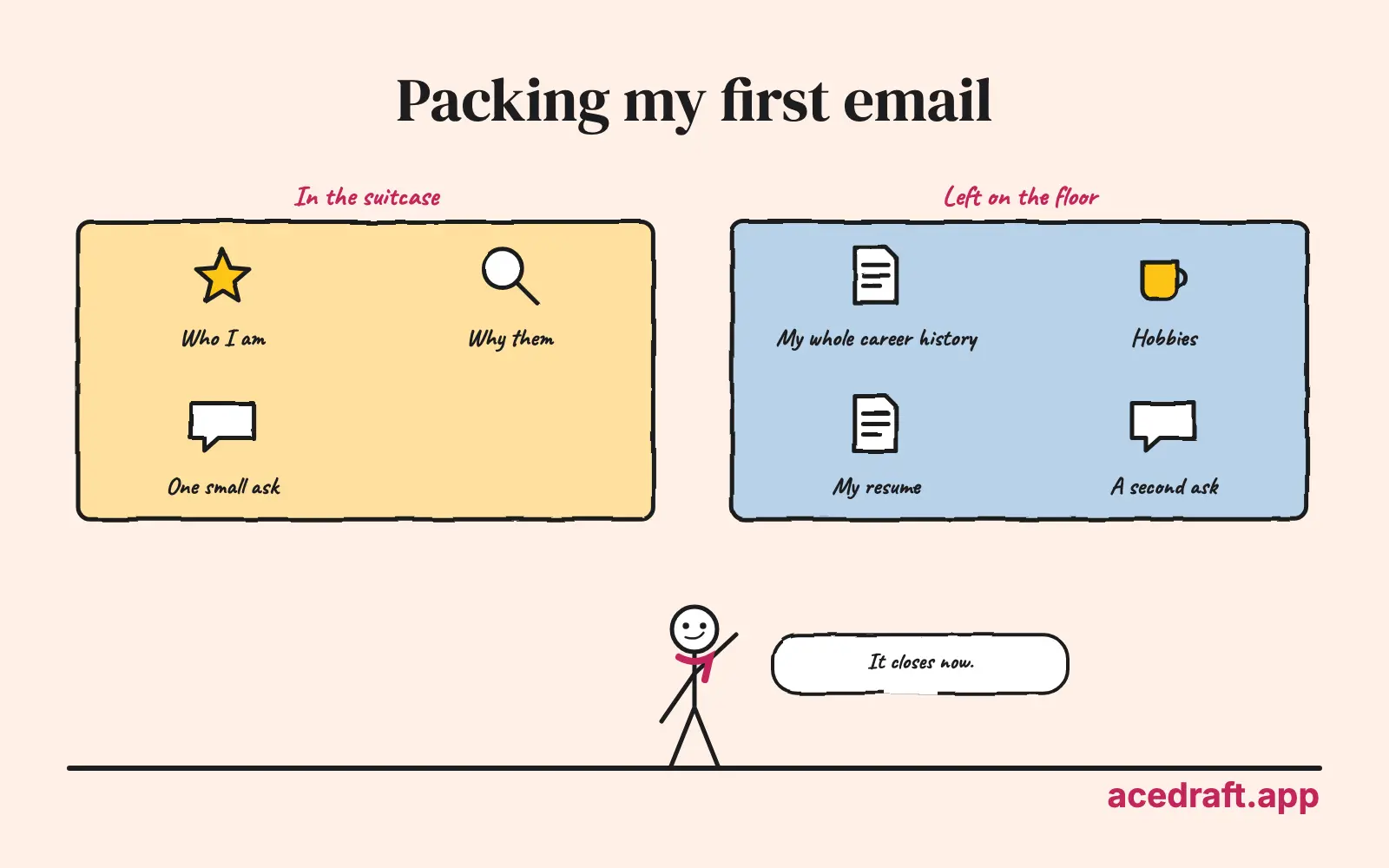
Here's the order I'd put the body in. It's my own layout, built from the pages above:
- Who you are and how you found them, in one or two sentences. Dartmouth's "Always include how you came across someone’s name" goes here.
- Why them in particular. Hamilton College's career center says to "Explain why you have chosen him/her to reach out to and state your goal for the meeting." One specific detail does more than a paragraph of praise.
- The ask, with a size. Twenty minutes on a call, or one question by email. Excelsior's page adds a point I'd keep: "Be flexible and respectful: defer to their schedule and availability, even if the time they offer is not ideal for you."
- Thanks and your name, plus one way to reach you.
If a draft needs a fifth part, I'd take that as a sign it's trying to do two jobs. Split it, and send the second email after they reply to the first.
What does a networking email template look like when I'm asking for a referral?
Name the exact posting and remind them how they know you. Then make it easy for them to say no. I'd only send one to someone who already knows you or has already spoken with you.
Here's why I hold that last view. The six pages I read are about first emails asking for advice, and two of them warn against asking for a job in those. Loyola Marymount says "do not ask for a job specifically" because "you may scare off your contact, who may have nothing to do with hiring." None of the pages covers referral requests in the lines I recorded, so the template below is mine.
Referral request: an example I wrote for this post, not sent.
Subject: Referral question about the [job title] role at [Company]
Hi [Name],
We worked together on [project] at [old company], and I've followed what [Company] has been doing since you moved there.
I've just seen the [job title] opening ([link or job ID]) and I'm planning to apply. It lines up closely with the [specific work] I've been doing at [current company].
Would you be comfortable referring me, or pointing me to the right person? If you'd rather not, that's completely fine, and I'd still be glad of ten minutes on what the team is like.
I've attached my resume so you can judge the fit before you decide.
Thanks,
[Your name]
[Phone or profile link]
A few choices in there are deliberate. The link or job ID means they don't have to hunt for the posting. The line "If you'd rather not, that's completely fine" is there because a referral puts their name next to yours, and they should feel free to decline. The resume is attached here, and only here, for the reason in the attachment section below.
What I left out: any line about how much you need this job. It's true for most people writing one of these, and it's still the wrong thing to put on someone you haven't spoken to in a while.
What if we haven't spoken in years?
Reconnect first, and ask later in a separate email. Writing to someone after three years of silence with a referral request in the first paragraph is the email equivalent of only phoning a cousin when you need a lift.
Reconnecting: an example I wrote for this post, not sent.
Subject: Hello from [your name], [shared team or place]
Hi [Name],
It's been a while since [shared thing]. I saw [their recent news, such as a new role or a talk] and it reminded me of [a specific memory or project].
I'm now [one line on what you do], and I've started looking at [field or kind of role]. No ask today. I mostly wanted to say congratulations and get back in touch.
If you're ever up for a catch-up call, I'd enjoy hearing how [Company] has been.
Best,
[Your name]
"No ask today" only works if it's true. If they reply and the conversation goes well, the referral email above can follow in a week or two, as its own message.
How do I email an alum or a stranger with no mutual contact?
Lead with the one real connection you have, even a thin one like the same university or a talk of theirs you watched, and ask for advice and a short conversation. Don't ask for the job.
People search for this as a cold email for job openings, and I understand why: it's the job you want. But every page I read that mentions it points away from asking in a first email. Job-Hunt.org: "DO make it clear that you are not asking for a job." Asking for twenty minutes of someone's experience is a much smaller favour than asking them to get you hired.
Alumni are the easiest version, because the school does the introducing. Jefferson's page suggests you "explain how they became a contact for you (alumnus, friend, family)", and for an alum that explanation is one line.
Emailing an alum: an example I wrote for this post, not sent.
Subject: [University] alum asking about [role] at [Company]
Hi [Name],
I found you through the [University] alumni directory. I graduated in [year] with a degree in [subject], and I'm now [what you do].
I'm hoping to move into [field], and your path from [their earlier role] to [their current role] is close to the one I'm trying to make.
Would you have 20 minutes in the next few weeks for a call? I'd like to ask how you made the move and what you'd do differently. I'm only after advice.
Any time that suits you works for me.
Thank you,
[Your name]
A complete stranger is harder, because there's no shared place to point to. What you can point to is their work: something they wrote or said that you actually read or heard. If you can't name one specific thing, I'd hold off and find one first.
This kind of email is usually a request for what career offices call an informational interview. Jefferson's sample ask is "Would you be available to meet for 20 minutes so that I can learn more about your profession and organization?" That conversation deserves its own guide, which I haven't written yet, so here's one example of the request and nothing more.
Informational interview request to a stranger: an example I wrote for this post, not sent.
Subject: Your talk on [topic]: one question from a [your role]
Hi [Name],
I watched your talk on [topic] at [event], and the point about [specific thing] has stuck with me. I'm a [your role] at [company], and I'm looking at moving into [their field].
We don't have a mutual contact, so I'll keep this brief. Could I ask you a few questions about what [their kind of work] looks like day to day? Fifteen or twenty minutes on a call would be plenty, at whatever time suits you.
If now's a bad time, I completely understand. Thank you for reading.
[Your name]
[Profile link]
If you're writing because you're changing fields, the email can say so in one plain line, as both examples do. The resume side of a switch is its own job, and I wrote about it in resume for a career change: tips for switching fields.
How do I write the follow-up email when nobody replies?
Send one short follow-up in the same thread after about a week, then stop. The pages I read disagree on how long to wait, so "about a week" is my own pick from their range.
Here's the disagreement, side by side. Jefferson: "Wait a week from the first time you contacted them." Dartmouth: "If you do not hear back within 5 to 7 days, follow up with another email inquiring if they received your initial email." Job-Hunt.org: "Do wait at least 2 or 3 business days before sending this message."
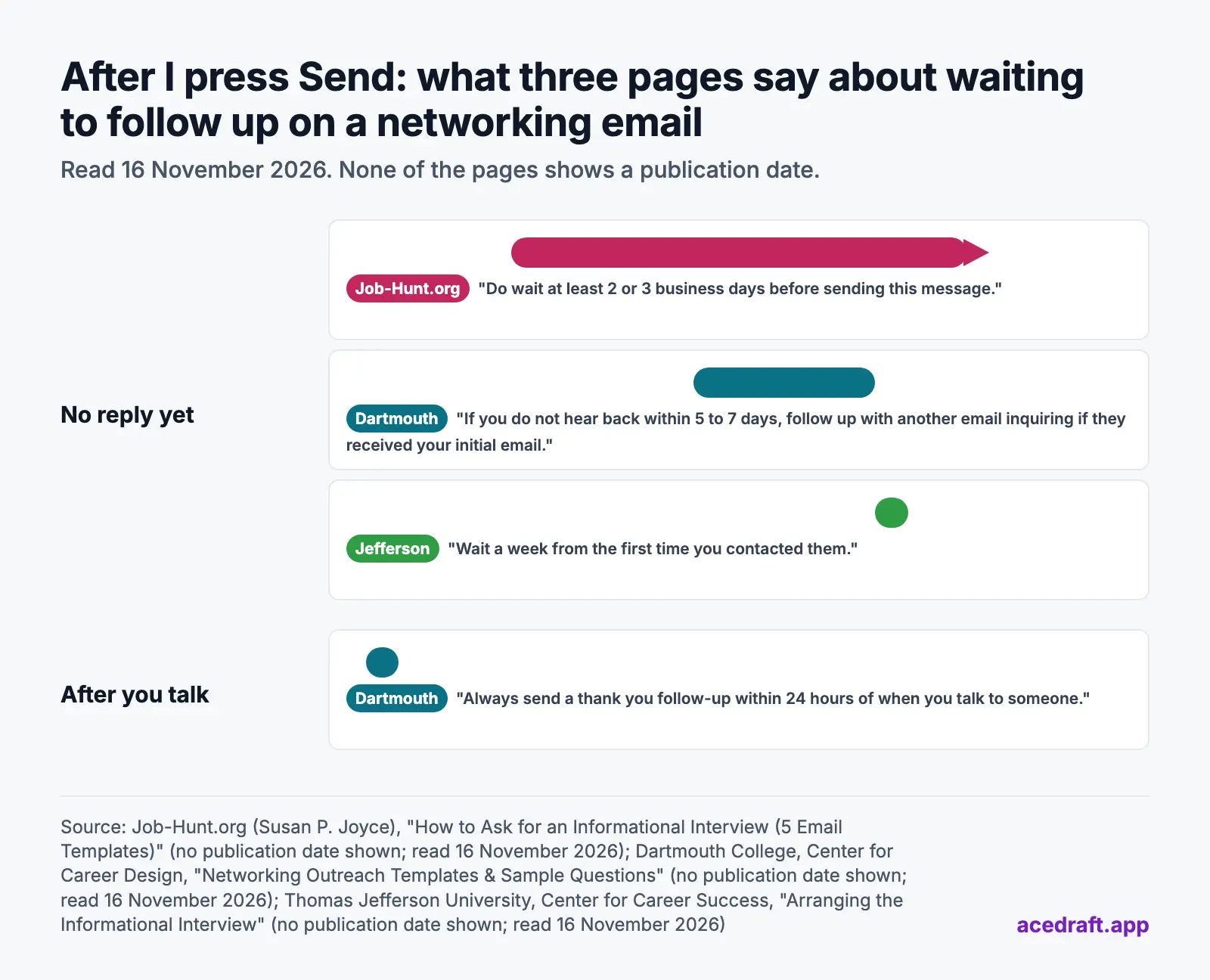
| Point | What the source says | Source |
| No reply yet | "Do wait at least 2 or 3 business days before sending this message." | Job-Hunt.org (Susan P. Joyce), "How to Ask for an Informational Interview (5 Email Templates)" |
| No reply yet | "If you do not hear back within 5 to 7 days, follow up with another email inquiring if they received your initial email." | Dartmouth College, Center for Career Design, "Networking Outreach Templates & Sample Questions" |
| No reply yet | "Wait a week from the first time you contacted them." | Thomas Jefferson University, Center for Career Success, "Arranging the Informational Interview" |
| After you talk | "Always send a thank you follow-up within 24 hours of when you talk to someone." | Dartmouth College, Center for Career Design, "Networking Outreach Templates & Sample Questions" |
Sources: Job-Hunt.org (Susan P. Joyce), "How to Ask for an Informational Interview (5 Email Templates)" (no publication date shown; read 16 November 2026); Dartmouth College, Center for Career Design, "Networking Outreach Templates & Sample Questions" (no publication date shown; read 16 November 2026); Thomas Jefferson University, Center for Career Success, "Arranging the Informational Interview" (no publication date shown; read 16 November 2026).
Why a week? Job-Hunt.org's figure is a minimum, "at least", and a week clears it. It matches Jefferson exactly and sits at the end of Dartmouth's range. So a week is the one wait none of the three would call too soon. None of them says that; it's my reading of their wording.
Dartmouth's line also gives you the content: ask whether they got the first email. That's a kinder question than "did you ignore me", and it leaves them a way back in.
Follow-up when nobody replies: an example I wrote for this post, not sent.
Subject: Re: [original subject]
Hi [Name],
I'm following up on my email from [day] in case it got buried. I'd still really value [the specific ask, for example 20 minutes on how you moved into product design].
If the timing's wrong, no problem at all, and thanks for reading either way.
[Your name]
Replying in the same thread matters more than it looks. The person sees your first email right underneath, so you don't have to repeat yourself, and the follow-up can stay three sentences long.
After that one follow-up, my rule is to stop. None of the sources covers a second follow-up in the lines I recorded, so this is only my view: a third email to the same silence takes your time and tells you nothing the second one didn't. Make a note of the date and spend the effort on the next person on your list.
What should the thank-you after a chat say?
It should thank them for something specific they said, and it should go out fast. Dartmouth says: "Always send a thank you follow-up within 24 hours of when you talk to someone." Hamilton says to "thank this person for his or her time and consideration."
Job-Hunt.org widens it: "DO send a thank you to anyone who speaks with you or refers you to someone else (even if that connection doesn’t happen)." I like the bracket in that line. The person who tried to introduce you did you a favour whether or not it worked out.
Thank-you after a chat: an example I wrote for this post, not sent.
Subject: Thank you for the call on [day]
Hi [Name],
Thank you for your time today. Your point about [specific thing they said] was the most useful thing I've heard on this, and I'm going to [what you'll do with it] this week.
[If they suggested someone:] I'll write to [person] and mention that you suggested it.
I'll let you know how it goes.
Best,
[Your name]
"I'll let you know how it goes" is a promise, so keep it. A short note a month later saying what happened is the easiest reason you'll ever have to write to them again.
Should I attach my resume to a networking email?
Not to a first email asking for advice, in my view. Attach it when you're asking for a referral to a specific posting, or when they ask to see it.
None of the six pages covers attachments in the lines I recorded, so this whole section is my reasoning. A resume attached to a stranger's first email reads like an application, and that clashes with the career pages' advice not to ask for a job. And opening a file from a stranger is something a careful person might reasonably skip.
If you want them to know it exists, offer it in one line instead: "I'm happy to send my resume if it would be useful." They can say yes in a word.
When you do attach it:
- Send a PDF, so it looks the same on their screen as on yours.
- Name the file with your name, like [First]-[Last]-resume.pdf, so it isn't "resume_final_v3" in their downloads folder.
- If it's for a referral, use the version you tailored for that posting, and say in the email which role it's for.
If your resume is in AceDraft, here's what the export does and doesn't do, as of 16 November 2026. After you Save in the guest editor, you can download a free ATS-ready plain-text PDF with no sign-up, no payment and no watermark, with your resume exactly as you wrote it. There's also a paid polished export, which needs Google sign-in and is paid once per export with no subscription. I wrote up both in exporting your resume from AceDraft: PDF and what it costs. Neither export offers DOCX.
What haven't I tested?
Whether any of these emails gets a reply. None of my six sources measured that either. Here's what else I haven't covered:
- I didn't send any of the example emails. All six are my own wording, written for this post, and none of them is a quote from a source or a real message.
- I have no reply-rate or open-rate data for any subject line or template, mine or anyone else's.
- I read six pages: five from US colleges and universities, and Job-Hunt.org. A seventh page redirected and I didn't read it. I have no Indian or UK source, so I can't tell you whether career offices there advise anything different.
- No page gives a word limit. The 150-word figure is my rule, and the one-week wait is my pick from three sources that disagree.
- No page shows a publication date (Excelsior's footer says 2025), so I can't tell when any of this advice was last reviewed. I recorded these lines on 16 November 2026.
- None of the pages covers referral requests, reconnecting or attachments in the lines I recorded. Those sections are my judgement.
Send the email if you can name how you found the person and one specific reason you picked them. Keep it under 150 words and ask for 20 minutes. Then set a reminder for a week from today.
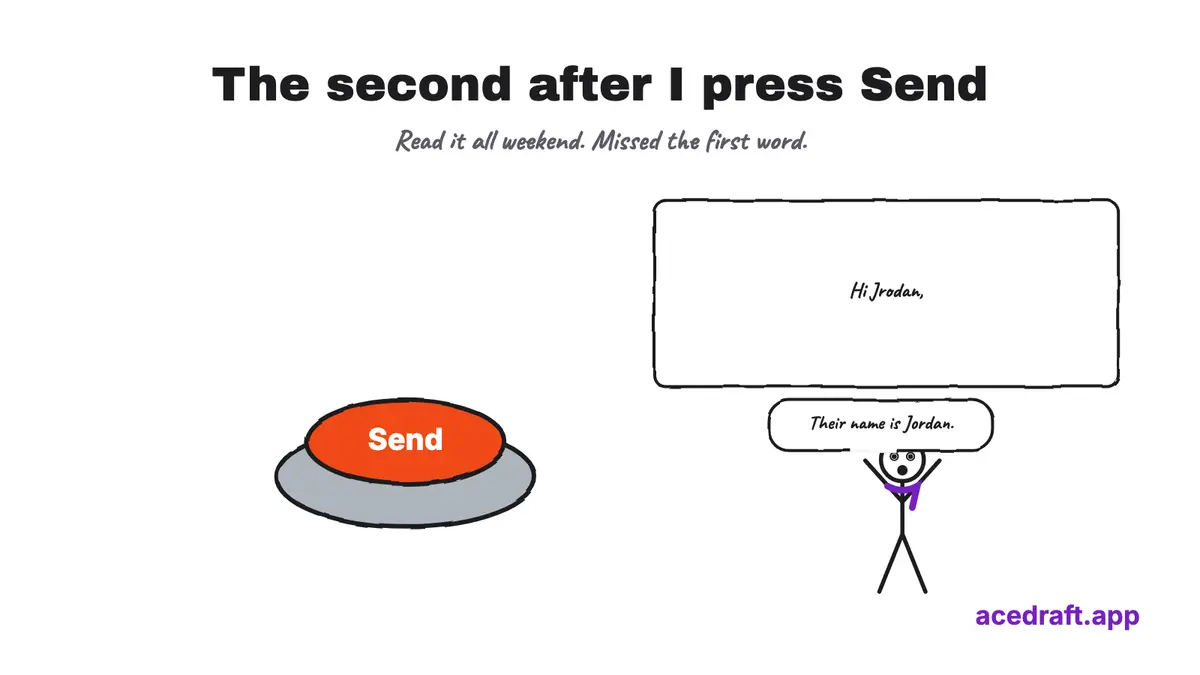
Don't send it yet if the only reason you're writing is that they work somewhere you want to work. Find the connection first. And check the spelling of their name one more time, because the doodle at the top isn't entirely a joke.
Sources
- Loyola Marymount University, Career and Professional Development, "How to Request an Informational Interview". The page shows no date; I read it on 16 November 2026.
- Hamilton College, Maurice Horowitch Career Center, "Networking Email". The page shows no date; I read it on 16 November 2026.
- Dartmouth College, Center for Career Design, "Networking Outreach Templates and Sample Questions". The page shows no date; I read it on 16 November 2026.
- Excelsior University, Online Writing Lab, "Requesting an Informational Interview". The page shows no publication date (footer 2025); I read it on 16 November 2026.
- Thomas Jefferson University, Center for Career Success, "Arranging the Informational Interview". The page shows no date; I read it on 16 November 2026.
- Job-Hunt.org (Susan P. Joyce), "How to Ask for an Informational Interview (5 Email Templates)". The page shows no date; I read it on 16 November 2026.
Frequently asked questions
What is a networking email?
What is a good networking email subject line?
Why do career pages disagree on when to follow up on a networking email?
What should a follow-up email say if nobody replied?
Should I send a thank-you email after a networking call?
Should I attach my resume to a networking email?
Is a cold email for a job the same as a networking email?
Can AceDraft write my networking email or cover letter?
Can I get a free PDF of my resume to attach to a networking email?
Share this post
Know someone job-hunting? Send it their way.
Comments
No comments yet. Be the first to comment.