Job Search Strategy: How to Build One, Week by Week
 Gowri Shanker·Nov 16, 2026
A job search strategy is your plan for finding work, written down: which roles you're aiming for, where you'll look for them, how you'll split each week, and how you'll keep track of what you sent and who you spoke to. This guide builds that plan one week at a time, so it ends up as a calendar you can follow on a tired Thursday as well as an eager Monday.
Two things before the plan. First, I build AceDraft, a resume builder, and it has no job tracker, no job board and no planner. The tracking in this post happens in a spreadsheet or a notebook, because I haven't built anything for it.
Second, I looked for a study showing that people with a weekly job search plan get hired faster, and I didn't find one. What I have is six university career pages I read on 16 November 2026, plus my own suggestions, which I'll label as mine. Five of the six show no publication date. And the number these pages repeat about jobs that are never advertised turns up with no source behind it.
Key takeaways
- Three of the five career pages in my grid say you need a plan. Indiana University South Bend: "a plan of action, or strategy, is required" (read 2026).
- Start small: McMaster University's weekly scheduler suggests an hour a day or 5 hours a week, starting with what you can manage (McMaster University, 2025).
- Four of the five pages in my grid tell you to spend time networking, on top of reading job posts (McMaster, 2025; Indiana Tech, IU South Bend and Nebraska-Lincoln, read 2026).
- Keep one record of applications, follow-up dates and the people you've talked to (Indiana Tech Career Center, read 2026).
- Limitation: the share of jobs that are "hidden" is given on three of these pages (two as a percentage, one as "more than half"), none names a source, and I couldn't find one, so this post doesn't treat it as fact.
What's in this guide
- What is a job search strategy, and do I actually need one?
- How do I decide which roles to aim for first?
- How should I split a week between applying, networking and interview prep?
- How do I tailor applications without rewriting my resume every time?
- How do I track applications so nothing falls through?
- When should I follow up, and when should I move on?
- How do I know the plan isn't working, and what do I change?
- What haven't I tested?
What is a job search strategy, and do I actually need one?
It's the handful of decisions you make once, before you apply, so you don't remake them every morning. And yes, you need one. Three of the five pages in my grid say so directly: McMaster, Indiana Tech and IU South Bend.
The tiles below show which of five university career pages gives which piece of advice: the more pages give a tip, the bigger its tile. I read each page on 16 November 2026, and the grid under the picture lists every page's answer.
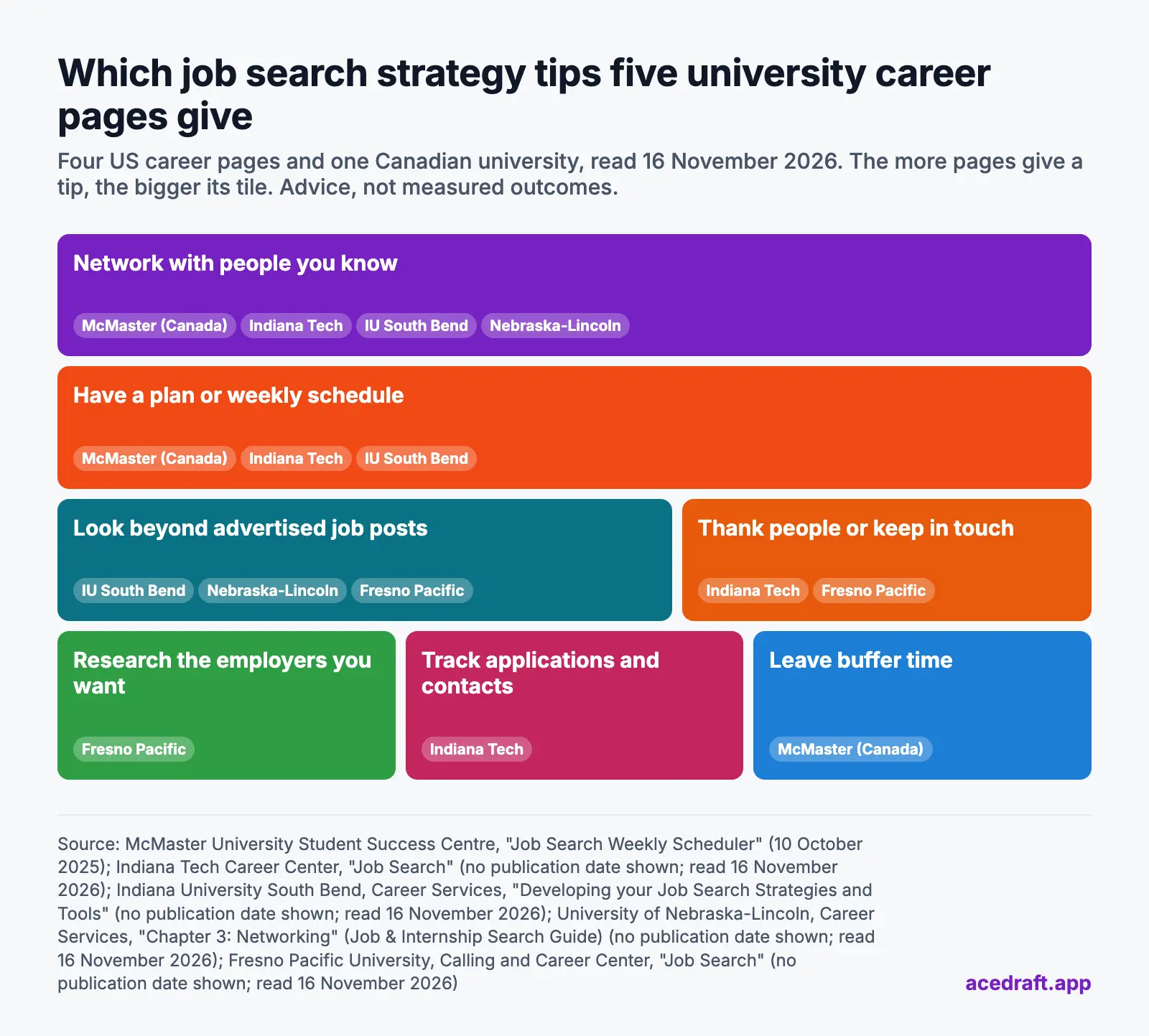
| Advice | McMaster (Canada) | Indiana Tech | IU South Bend | Nebraska-Lincoln | Fresno Pacific |
| Network with people you know | Yes | Yes | Yes | Yes | Not stated |
| Have a plan or weekly schedule | Yes | Yes | Yes | Not stated | Not stated |
| Look beyond advertised job posts | Not stated | Not stated | Yes | Yes | Yes |
| Thank people or keep in touch | Not stated | Yes | Not stated | Not stated | Yes |
| Research the employers you want | Not stated | Not stated | Not stated | Not stated | Yes |
| Track applications and contacts | Not stated | Yes | Not stated | Not stated | Not stated |
| Leave buffer time | Yes | Not stated | Not stated | Not stated | Not stated |
Sources: McMaster University Student Success Centre, "Job Search Weekly Scheduler" (10 October 2025); Indiana Tech Career Center, "Job Search" (no publication date shown; read 16 November 2026); Indiana University South Bend, Career Services, "Developing your Job Search Strategies and Tools" (no publication date shown; read 16 November 2026); University of Nebraska-Lincoln, Career Services, "Chapter 3: Networking" (Job & Internship Search Guide) (no publication date shown; read 16 November 2026); Fresno Pacific University, Calling and Career Center, "Job Search" (no publication date shown; read 16 November 2026).
Nebraska-Lincoln's page is a chapter about networking, so it has no reason to talk about buffer time.
I read a sixth page, from Brown University's Master's Career Services, but it isn't in the grid. The only line I recorded from it is a statistic about unadvertised jobs, and that statistic is the problem I come back to below.
Where they agree, they agree clearly. Indiana University South Bend: "To be successful in your job search, a plan of action, or strategy, is required." Indiana Tech gives the reason: "A strategic approach to finding a job improves your efficiency and increases your chances of finding the right opportunity." McMaster's page is a weekly scheduler, which makes the same point just by existing.
Three of them also say job posts shouldn't be the only place you look, and four tell you to network. Nebraska-Lincoln calls networking "the best strategy to search for jobs and career opportunities." Indiana Tech tells you to "Inform your contacts about your search, ask for referrals and introductions, and maintain relationships".
One caution about the grid. These pages were written by career advisers to help students and alumni. Their agreement tells you what career advisers recommend. It doesn't tell you what gets people hired, because none of them measured that.
Is the hidden job market real, and how big is it?
All four pages in the picture below say some jobs are never advertised, and three of them put a share on it. How big that share is, I can't tell you, because none of them says where its number comes from.
Brown's page says: "80% of jobs are not posted on job boards or company websites." Fresno Pacific asks: "Did you know that 80% of jobs are hidden and never show up on job search websites?" Indiana University South Bend says "more than half of all available positions are never advertised". None of the three names a survey, a study or a year. I went looking for an original source and didn't find one.
So I'm treating the figure the way I'd treat any number with no source behind it: as something people repeat, not something I can check. Fresno's page also gives other figures about referrals and recruiters, again with no source, so I've left those out too.
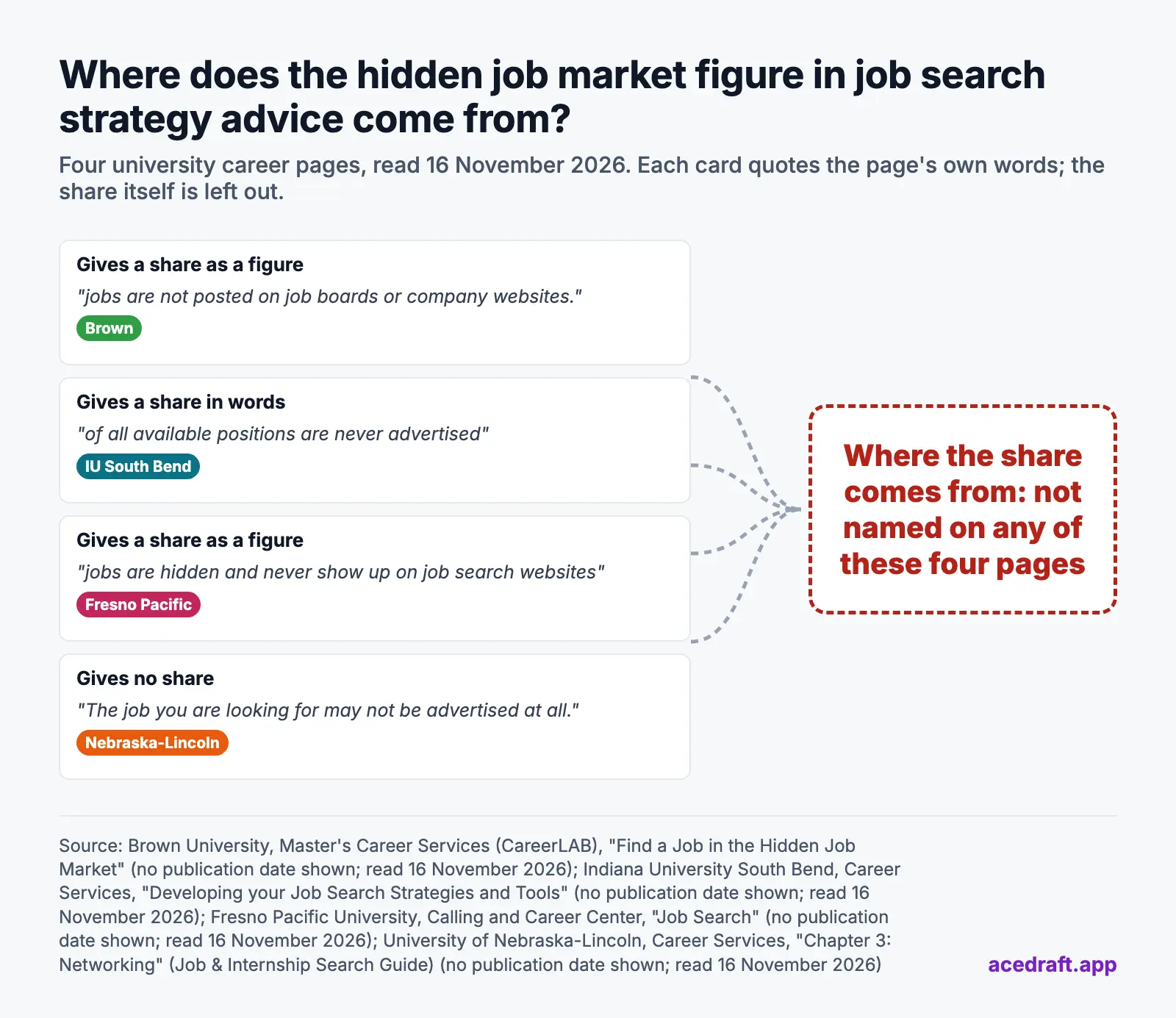
| Point | What the source says | Source |
| Gives a share as a figure | "jobs are not posted on job boards or company websites." | Brown University, Master's Career Services (CareerLAB), "Find a Job in the Hidden Job Market" |
| Gives a share in words | "of all available positions are never advertised" | Indiana University South Bend, Career Services, "Developing your Job Search Strategies and Tools" |
| Gives a share as a figure | "jobs are hidden and never show up on job search websites" | Fresno Pacific University, Calling and Career Center, "Job Search" |
| Gives no share | "The job you are looking for may not be advertised at all." | University of Nebraska-Lincoln, Career Services, "Chapter 3: Networking" (Job & Internship Search Guide) |
| Where the share comes from: not named on any of these four pages |
Sources: Brown University, Master's Career Services (CareerLAB), "Find a Job in the Hidden Job Market" (no publication date shown; read 16 November 2026); Indiana University South Bend, Career Services, "Developing your Job Search Strategies and Tools" (no publication date shown; read 16 November 2026); Fresno Pacific University, Calling and Career Center, "Job Search" (no publication date shown; read 16 November 2026); University of Nebraska-Lincoln, Career Services, "Chapter 3: Networking" (Job & Internship Search Guide) (no publication date shown; read 16 November 2026).
The good news is that the useful advice doesn't need the number. Nebraska-Lincoln says "Online job postings draw large pools of applicants," and "The job you are looking for may not be advertised at all." Both are reasons to give some of your week to talking to people, whatever the true share turns out to be.
What goes on a job search checklist?
Here's the job search checklist I'd fill in on day one. It's my own list, pulled together from the advice in the grid, and most lines take minutes:
- The two or three kinds of role you're aiming for first. The next section is about choosing them.
- A short list of employers you'd like to work for, each with one line on why.
- The hours you're giving the search, written into your calendar like any other appointment.
- A master resume with everything on it, kept apart from the copies you send.
- A tracker, even if it's one page of a notebook.
- Five people you could tell about your search this week, by name.
How do I decide which roles to aim for first?
Aim first at roles where three things overlap: you actually want the job, you can point to proof that you could do it, and it's hiring somewhere you're able to work.
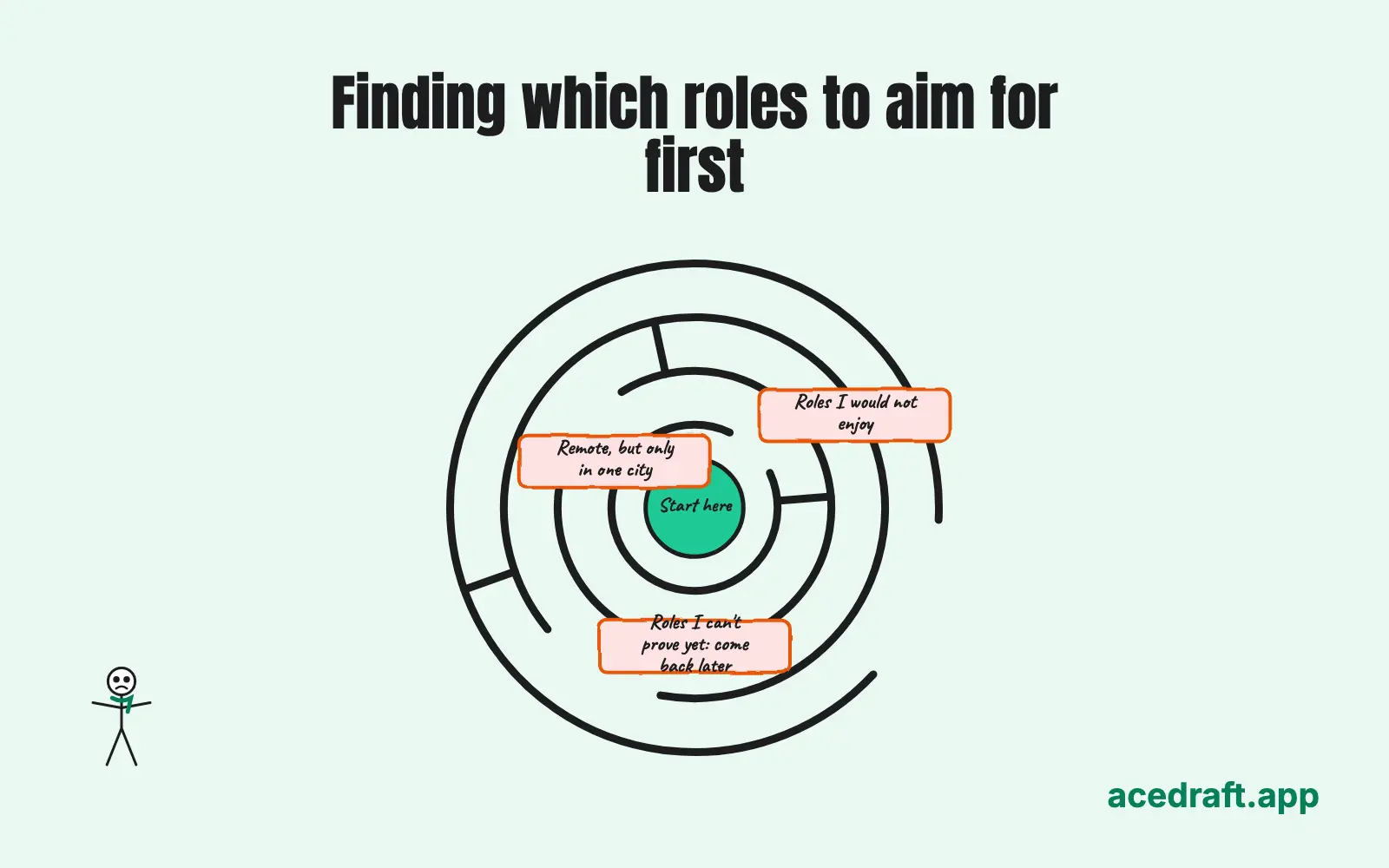
That doodle is a joke, but the middle of it is the real advice. The career pages don't spell this one out; it's how I'd choose.
Roles you actually want. This sounds obvious. It stops being obvious a few weeks in, when every posting starts to look like something you could probably do. I'd expect a plan with a clear target to be easier to stick to, and it gives every week something to aim at.
Roles you can show proof for. Proof means something on your resume an employer can check: a job, a project, a course, a result you can describe. If a posting's main requirements are all things you've never done, it can still be a goal. I'd put it in the second wave.
Roles hiring where you can work. Location, the right to work in that country, and whether "remote" really means remote or means remote within one city. It's easy to spend an evening on an application before noticing the line that rules you out. Read that line first.
Then turn the overlap into a list of employers. Fresno Pacific's advice fits here: "Learn all you can about the companies for which you are interested." I'd keep the list short enough to know each employer properly, somewhere between ten and twenty to start. That number is mine, not a source's, and the list should grow as you go.
Job boards are fine for finding names for that list. I'd use them as one source among several, which is where three of the pages in the grid point as well.
How should I split a week between applying, networking and interview prep?
Give each of the three its own slot in your calendar, and start with fewer hours than you think you need. McMaster's weekly scheduler says: "Aim for an hour a day or a total of 5 hours in a week, but start with what you can manage and work from there."
That's the only time figure in any of the six sources. Nobody says how to divide those hours.
McMaster does name the pieces: "Be sure to balance your time with searching for opportunities, networking and preparing your applications." It also tells you to include time for meals, sleep and exercise, and to "leave some blank 'buffer time' every day to handle any unexpected changes."
Buffer time is the part I'd most like you to copy. A plan with no gaps breaks the first time an interview moves or a deadline at your current job lands on a Tuesday. Then the whole week feels like a failure, and it's tempting to drop the plan instead of the one task.
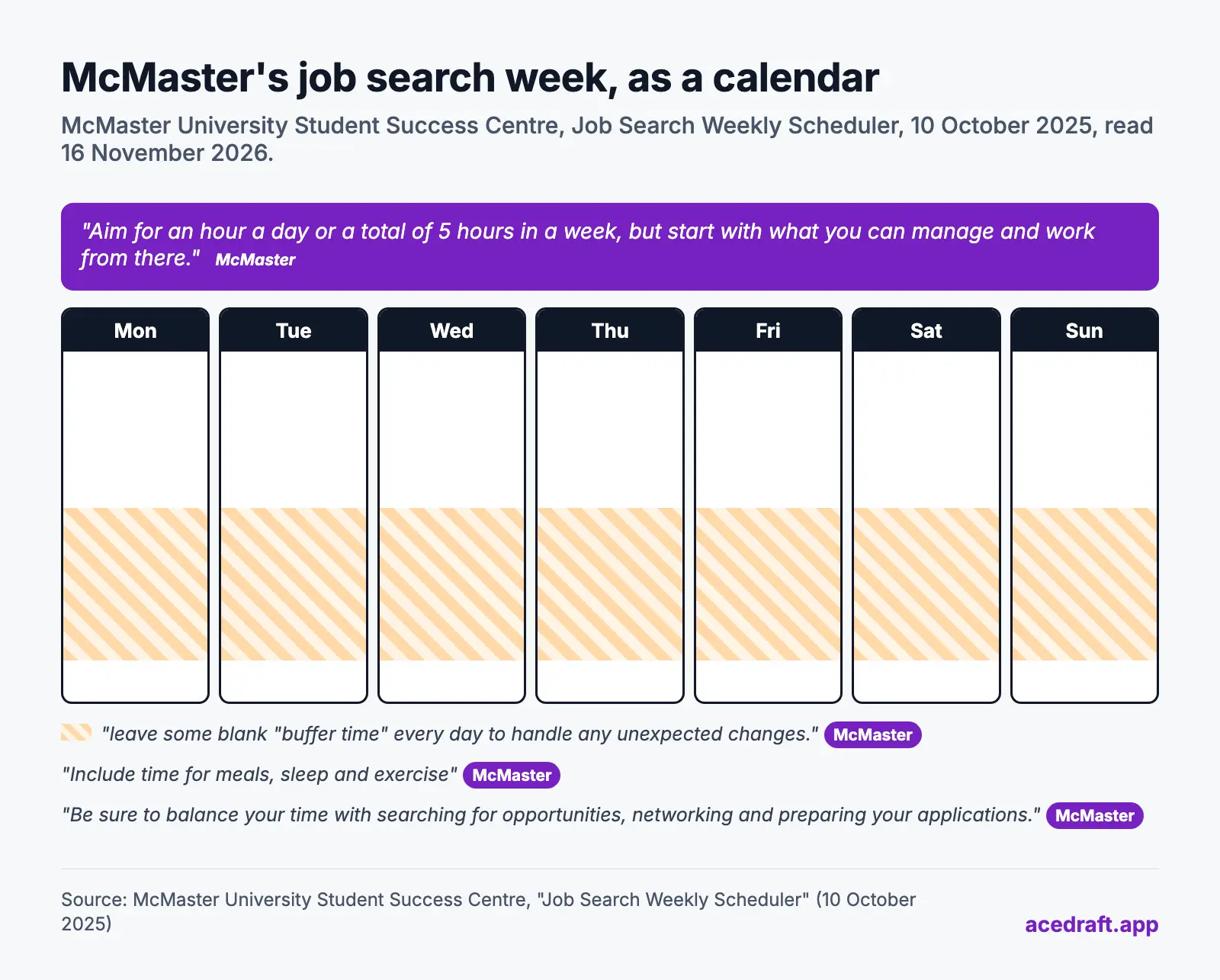
| Point | What the source says | Source |
| Time | "Aim for an hour a day or a total of 5 hours in a week, but start with what you can manage and work from there." | McMaster University Student Success Centre, "Job Search Weekly Scheduler" |
| Buffer time | "leave some blank "buffer time" every day to handle any unexpected changes." | McMaster University Student Success Centre, "Job Search Weekly Scheduler" |
| Meals, sleep and exercise | "Include time for meals, sleep and exercise" | McMaster University Student Success Centre, "Job Search Weekly Scheduler" |
| What to balance | "Be sure to balance your time with searching for opportunities, networking and preparing your applications." | McMaster University Student Success Centre, "Job Search Weekly Scheduler" |
Sources: McMaster University Student Success Centre, "Job Search Weekly Scheduler" (10 October 2025).
Here's an example week I wrote for this post, for someone with about 5 hours to give, following McMaster's suggestion. It isn't taken from any source, and you should move the days around your real life:
| Day | What I'd do | Time |
| Monday | Search: check saved searches and the employer list, and pick this week's two or three openings | 1 hour |
| Tuesday | Apply: tailor a resume copy for the first opening and send it | 1 hour |
| Wednesday | Network: one message to someone new, one to someone you already know | 45 minutes |
| Thursday | Apply: the second application, then update the tracker | 1 hour |
| Friday | Interview prep, or a third application if nothing is booked | 45 minutes |
| Every day | Buffer: left blank on purpose, and not counted in the 5 hours | About 15 minutes |
Notice that applying gets two slots and networking gets one. That's my choice for someone starting out, because applications are the part with deadlines. If postings are getting you nowhere, swap them round. The section on changing the plan covers when to do that.
The networking slot is for telling people you're looking and asking a few of them to talk. Indiana Tech's advice covers the first half, and Nebraska-Lincoln covers the second: ask someone "for a meeting or phone call to learn from them about it and/or their employer." That kind of conversation is often called an informational interview. If you're starting with no contacts at all, I wrote about that in how to network: building a professional network from zero, including what to say in a first message.
Where does interview prep fit?
Interview prep gets the Friday slot until an interview is booked, and then it takes whatever slots it needs that week. None of the six career pages covers interview prep in the lines I recorded, so that timing is my own view.
The research you did for your employer list feeds straight into it, since you'll already know what each company does. I won't list questions here. If you want a set to practise, I grouped the behavioral ones by what each one tests in behavioral interview questions grouped by what they test.
How do I tailor applications without rewriting my resume every time?
Keep one long master resume with everything on it, and for each job make a short copy that moves the most relevant points to the top and uses the posting's own words where they're true for you. Each copy starts from the master, so you never begin from a blank page.
None of the six career pages covers tailoring in the lines I recorded. Here's the order I'd work in:
- Read the posting once, all the way through, and mark the requirements it repeats or calls required.
- Find the matching lines in your master resume. If a main requirement has no match, write that in your tracker. Don't invent one.
- Move those lines up. In my view the first few bullets under each job do the most work, so put the matches there.
- Swap in the posting's words where they describe what you actually did. If the posting says "stakeholder reporting" and you wrote "sent updates to managers", and it's the same work, use their phrase.
- Save the copy with the employer's name in the file name, and note in the tracker which version went where.
The last step matters more than it looks. When someone calls weeks later about an application, you want to know which version of you they're holding.
I've written the longer version of this method in how to tailor a resume to a job description without rewriting it. If you use AceDraft, how to build a job-specific resume in AceDraft walks through doing it in the editor I built. And there's a pre-apply checklist for your resume for the last look before you send.
How many applications a week? None of my sources gives a number. Indiana Tech says to "Set weekly goals for applications and networking activities", which leaves the number up to you. I'd rather send two well-matched applications than ten near-copies, but that's a preference. I have no data showing which works better.
How do I track applications so nothing falls through?
Keep one row per application in a single place, with the role, the date you applied, a link to the posting, the people involved and the next step with a date next to it.
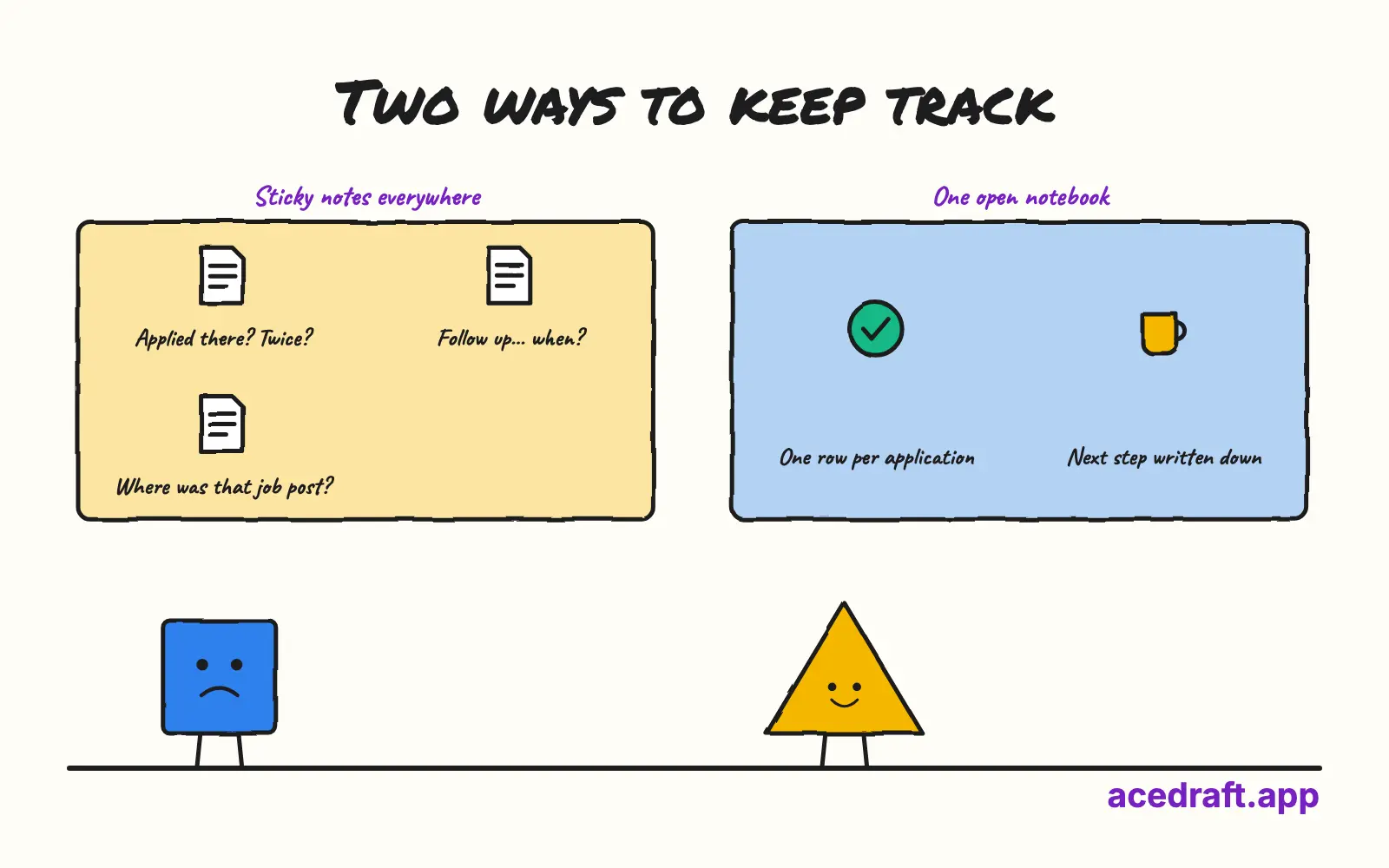
The left side of that doodle is the default if you don't decide otherwise: everything lives in your head and your inbox, and both forget things.
Indiana Tech is the only one of the six that covers this, at least in the lines I recorded: "Find a system for keeping track of your applications, follow-up dates, people you've interacted with". That surprised me, since the rest of the plan depends on it.
Any system works. A spreadsheet or a paper notebook will do the job. People search for a "job application tracker" as if it were an app they have to find first, and apps for it do exist, but the columns matter more than the software.
Here are the columns I'd use. It's my own layout:
| Column | What goes in it |
| Employer and role | The company name and the exact job title from the posting |
| Date applied | The day you sent it |
| Link and saved copy | The posting's link, plus a saved copy of the text, because postings can be taken down |
| Resume version | The file name of the copy you sent |
| People | Anyone you've spoken to or emailed about it, and how you know them |
| Next step and date | What happens next, in a few words, and the day you'll check or follow up |
| Status | Applied, talking, interviewing, offer or closed |
The people column is the one I'd fight for. Indiana Tech puts people in the same sentence as applications, and I think that's right. A contact from one application is worth keeping for the next opening at the same employer.
Update the tracker at the end of each apply slot. If you leave it for later, later is how you end up on the left side of the doodle.
When should I follow up, and when should I move on?
Follow up once, politely, when the date in your tracker comes round, and after that stop waiting and give the time to your next application. None of my sources gives a number of days, so the timing in this section is my own view.
What the sources do say is that follow-up belongs in your system. Indiana Tech lists "follow-up dates" among the things to track. Fresno Pacific adds the human part: "Always be grateful for those who are willing to help and thank them for their time and assistance."
Here's how I'd set the dates:
- Application with no contact name: set a check date about two weeks out. If the posting is still open then and you can find a way to reach the hiring team, one short note is fine.
- Application where you know someone there: thank that person the same week and tell them you've applied.
- After an interview: a thank-you the same day or the next, plus a check date for whenever they said you'd hear back.
- After a networking chat: thank them within a day or two, which is exactly the habit Fresno Pacific describes.
Moving on is the harder half. My rule: after one follow-up and no reply, mark the row as waiting and stop checking your inbox for it. Don't delete the row. If a reply does arrive late, the tracker means you'll know straight away which job it's about and which resume they saw.
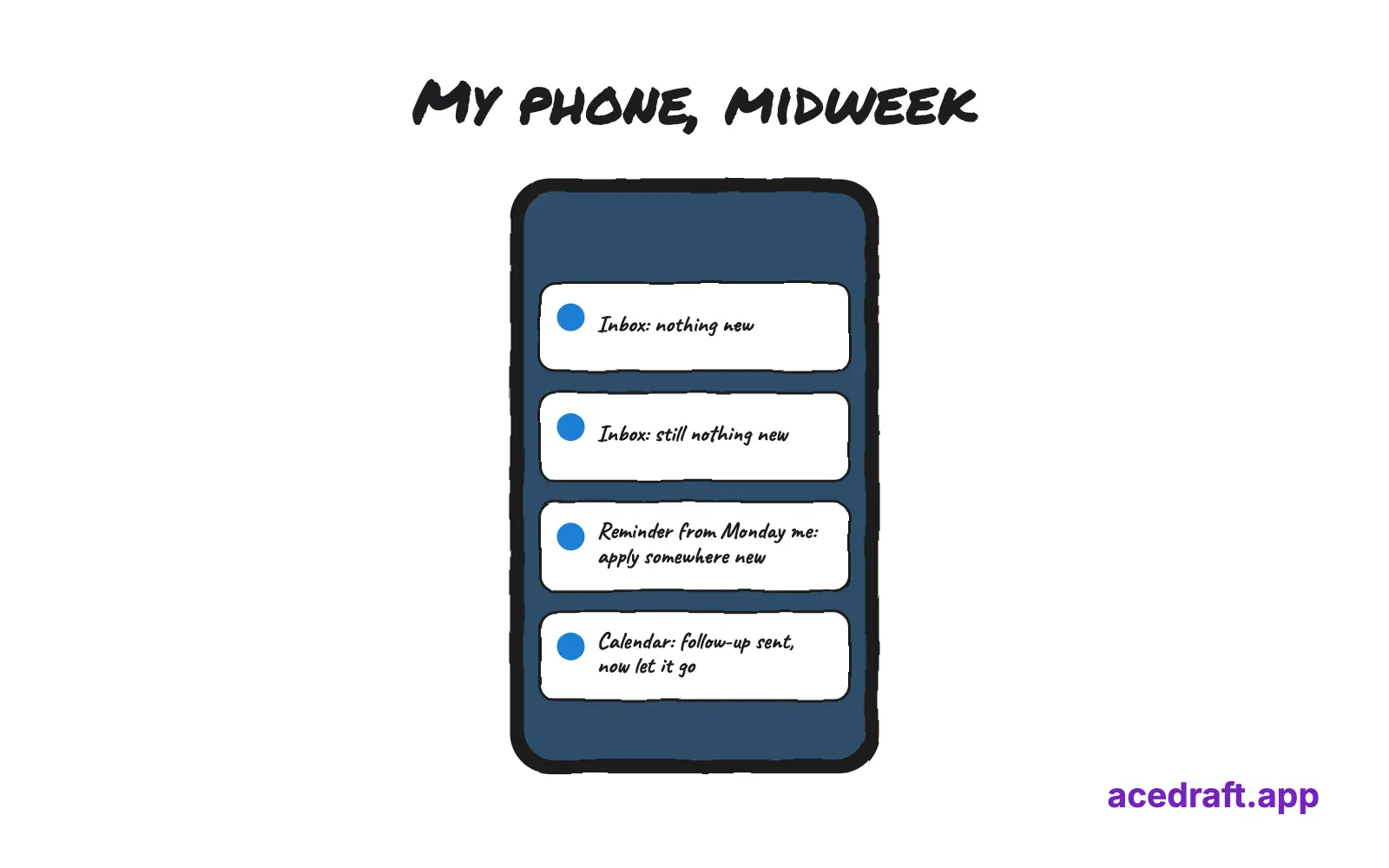
What I'd avoid is a third and fourth follow-up to the same silence. It takes time out of next week's plan, and in my view it rarely tells you anything the first silence didn't.
How do I know the plan isn't working, and what do I change?
Look at your tracker every couple of weeks and find the point where things stop, then change the step just before it. None of the pages describes a review step in the lines I recorded, so this is my own method, though McMaster's "start with what you can manage and work from there" points the same way.
Here's how I'd read the tracker. Each fix is a first thing to try, not a guarantee:
| What the tracker shows | What I'd change first |
| Applications go out, and almost nothing comes back | The roles you're aiming at, or how closely each resume copy matches its posting |
| Every row is a posting, and no row has a person in it | Move one apply slot to networking for a few weeks |
| Chats happen, but nobody offers an introduction | Ask more directly, at the end of the chat, whether there's someone else you should talk to |
| Interviews happen, but stop after the first round | Give interview prep more of the week and practise out loud |
| The slots keep getting skipped | Fewer hours and more buffer, then build back up |
The second row is the one I'd check first. Nebraska-Lincoln says "Online job postings draw large pools of applicants." If your tracker is all postings and no people, you're spending all your time where Nebraska-Lincoln says the crowds are.
The last row is the honest one. A plan that's too big for your real week doesn't fail loudly. It just quietly stops getting opened.
Keeping going when most of the tracker says "closed" is its own subject, and I'm saving it for a separate post. The one thing I'd say here is that a plan sized to your real week is easier to come back to after a bad one. That's what McMaster's advice and the buffer time are for.
What haven't I tested?
I haven't tested whether a weekly plan like this one helps anyone get hired faster, and none of my six sources measured it either. Here's what that leaves out:
- I didn't run a study. I compared six public university career pages, five in the US and one in Canada, and wrote down what each one says.
- I couldn't find a source for the hidden job market figures. Brown and Fresno Pacific give a percentage with no source named, and Indiana University South Bend says "more than half" with no source either.
- Only McMaster gives a time figure, and it's a suggestion, not a measurement.
- No source gives follow-up timing, a number of applications per week or a way to split the hours. Every number like that in this post is labelled as my own view, and the example week is wording I wrote.
- I have no Indian or UK source, so I can't say whether career offices there advise anything different. I couldn't load CareerOneStop, a US Department of Labor career site, or several university pages and PDFs.
- Five of the six pages show no date, so I can't tell when their advice was last reviewed. I recorded these lines on 16 November 2026.
I also haven't built a tracker or a planner, so there's nothing of mine to show you working here. The plan in this post runs on a calendar and a spreadsheet, and both of those you already have.
Build the plan if your search has gone past a couple of weeks of applying whenever you remember, or you can't say what you sent last week without checking your inbox. Write the checklist, book the hours and start the tracker today.
Skip the colour-coded version if you're about to spend a weekend making it. One page, a few columns, this week. You can make it pretty on Thursday, next to the snack.
Sources
- McMaster University Student Success Centre, "Job Search Weekly Scheduler". Dated 10 October 2025; I read it on 16 November 2026.
- Indiana Tech Career Center, "Job Search". The page shows no date; I read it on 16 November 2026.
- Indiana University South Bend, Career Services, "Developing your Job Search Strategies and Tools". The page shows no date; I read it on 16 November 2026.
- University of Nebraska-Lincoln, Career Services, "Chapter 3: Networking" (Job and Internship Search Guide). The page shows no date; I read it on 16 November 2026.
- Brown University, Master's Career Services (CareerLAB), "Find a Job in the Hidden Job Market". The page shows no date; I read it on 16 November 2026.
- Fresno Pacific University, Calling and Career Center, "Job Search". The page shows no date; I read it on 16 November 2026.
Frequently asked questions
What is a job search strategy?
How many hours a week should I spend on my job search?
Is it true that 80% of jobs are never advertised?
What should a job search checklist include?
How do I keep track of job applications?
When should I follow up on a job application?
Does AceDraft have a job tracker or job search planner?
Is the AceDraft resume export free?
Share this post
Know someone job-hunting? Send it their way.
Comments
No comments yet. Be the first to comment.