Common Interview Questions and How to Answer Each
 Gowri Shanker·Nov 16, 2026
Common interview questions are the general questions an interviewer can ask in almost any job interview, whatever the role: tell me about yourself, why do you want to work here, what are your strengths and weaknesses, and do you have any questions for us. They're about how you talk about yourself and the job, rather than one technical skill. This guide takes each one in turn and gives you a way to answer it.
Two concessions before the answers. First, I build AceDraft, a resume tool, and it has no interview tool. Nothing in this post leads to a product that writes or rehearses your answers, because I haven't built one.
Second, and this one matters more. I went looking for a survey or study of which answers interviewers actually prefer, and I didn't find one. So everything below comes from six university career pages I read on 16 November 2026, plus my own opinions, which I'll label as mine. Three of the six pages show no date at all. And on one question, the weakness one, they disagree with each other.
Key takeaways
- "Tell me about yourself" is a short, planned answer matched to the job, and the career pages warn against reciting your life story (University of Warwick, 2025; Joel Schwartzberg in Harvard Business Review, 2019, reposted by Duke University in 2022).
- Three of the six pages say to research the company before you go (UMBC, BYU-Pathway Worldwide and MCPHS University, read 2026).
- The weakness question is where they split. UMBC says the "tendency to take on too much" answer is overused, while BYU-Pathway and MCPHS say to turn a weakness into a positive (read 2026).
- Ask questions at the end, even if you think you have none (BYU-Pathway Worldwide, read 2026).
- Limitation: this is career-centre advice, not measured results, and none of the six pages covers salary or career gaps.
What's in this guide
- What are the most common interview questions?
- How do I answer "tell me about yourself"?
- How do I answer "why do you want to work here?"
- What do I say when they ask about my strengths and weaknesses?
- How do I explain why I'm leaving, or a gap in my resume?
- What should I say when they ask about salary expectations?
- What about the "tell me about a time" questions?
- What should I ask at the end of the interview?
- What haven't I tested?
What are the most common interview questions?
The most common interview questions are the general ones that fit any job: tell me about yourself, why do you want to work here, why should we hire you, what are your strengths and weaknesses, where do you see yourself, why are you leaving, what salary do you expect, and do you have any questions for us. That's my list, and the sections below take them in the order I'd expect to meet them.
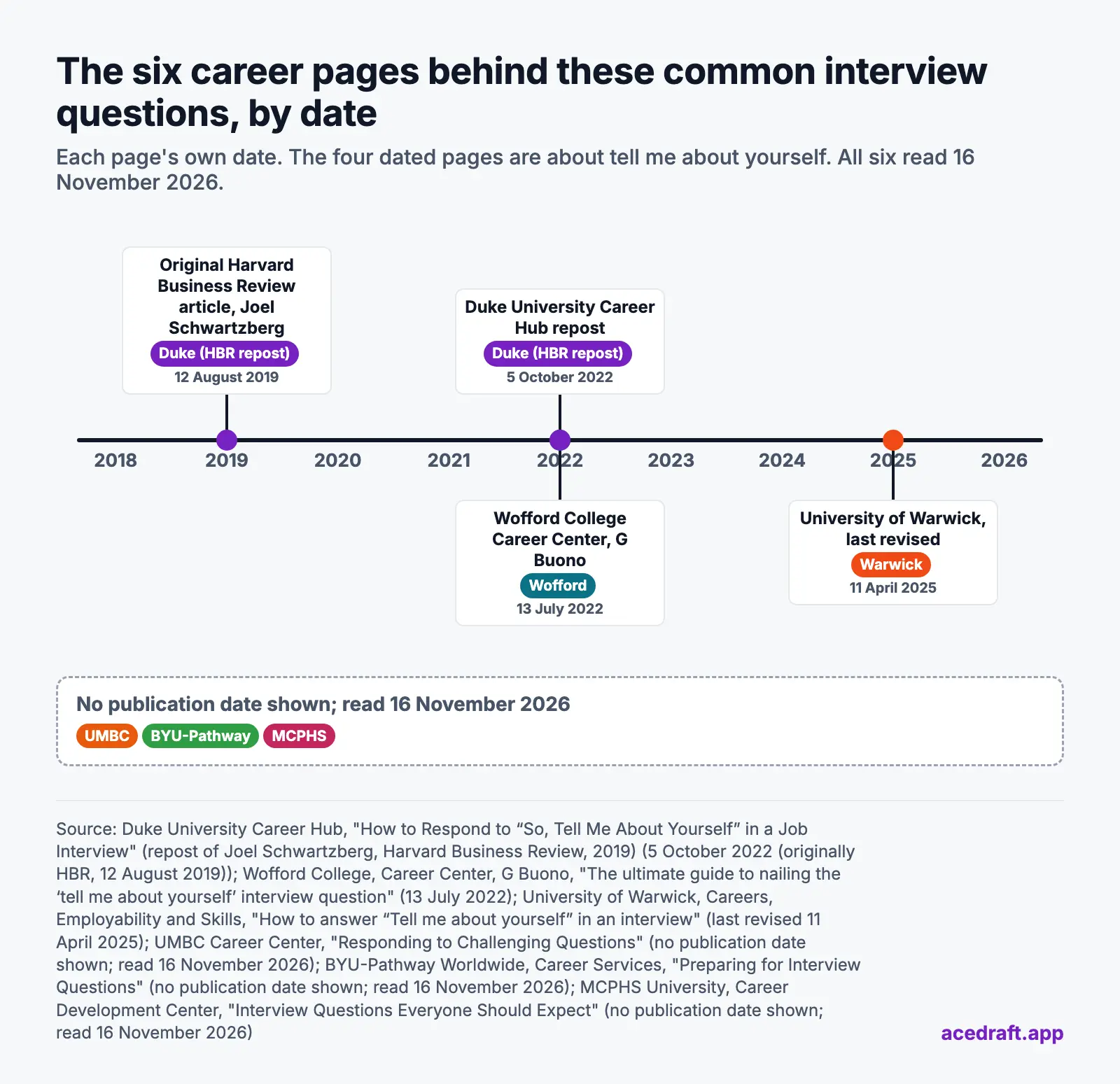
The timeline below shows when each of the six career pages was published or last revised, going by each page's own date, with the three undated pages set apart. I read all six on 16 November 2026.
| Page | Date shown | What it covers |
| Duke University Career Hub, "How to Respond to “So, Tell Me About Yourself” in a Job Interview" (repost of Joel Schwartzberg, Harvard Business Review, 2019) | 12 August 2019 | Original Harvard Business Review article, Joel Schwartzberg |
| Wofford College, Career Center, G Buono, "The ultimate guide to nailing the ‘tell me about yourself’ interview question" | 13 July 2022 | Wofford College Career Center, G Buono |
| Duke University Career Hub, "How to Respond to “So, Tell Me About Yourself” in a Job Interview" (repost of Joel Schwartzberg, Harvard Business Review, 2019) | 5 October 2022 | Duke University Career Hub repost |
| University of Warwick, Careers, Employability and Skills, "How to answer “Tell me about yourself” in an interview" | 11 April 2025 | University of Warwick, last revised |
| UMBC Career Center, "Responding to Challenging Questions" | No publication date shown | UMBC Career Center: challenging questions |
| BYU-Pathway Worldwide, Career Services, "Preparing for Interview Questions" | No publication date shown | BYU-Pathway Worldwide: preparing for interview questions |
| MCPHS University, Career Development Center, "Interview Questions Everyone Should Expect" | No publication date shown | MCPHS University: questions everyone should expect |
Sources: Duke University Career Hub, "How to Respond to “So, Tell Me About Yourself” in a Job Interview" (repost of Joel Schwartzberg, Harvard Business Review, 2019) (5 October 2022 (originally HBR, 12 August 2019)); Wofford College, Career Center, G Buono, "The ultimate guide to nailing the ‘tell me about yourself’ interview question" (13 July 2022); University of Warwick, Careers, Employability and Skills, "How to answer “Tell me about yourself” in an interview" (last revised 11 April 2025); UMBC Career Center, "Responding to Challenging Questions" (no publication date shown; read 16 November 2026); BYU-Pathway Worldwide, Career Services, "Preparing for Interview Questions" (no publication date shown; read 16 November 2026); MCPHS University, Career Development Center, "Interview Questions Everyone Should Expect" (no publication date shown; read 16 November 2026).
Three of the pages, Duke, Warwick and Wofford, are written about "tell me about yourself" alone, so their silence on weaknesses or closing questions is what you'd expect.
The six pages are these. Duke University's Career Hub reposted Joel Schwartzberg's Harvard Business Review piece on "tell me about yourself" on 5 October 2022 (the original ran on 12 August 2019). The University of Warwick's careers service page was last revised on 11 April 2025. G Buono's guide for the Wofford College Career Center is dated 13 July 2022. The UMBC Career Center, BYU-Pathway Worldwide's Career Services and the MCPHS University Career Development Center pages show no date; I read all three on 16 November 2026.
The one piece of advice three pages share is to research the company. UMBC says: "The employer expects you to show knowledge of and interest in the company." MCPHS is blunter: "You must research the company prior to the interview." BYU-Pathway tells you to "Research the company ahead of time to learn what they are passionate about."
Where they pull apart is the weakness question. BYU-Pathway and MCPHS both tell you to turn a weakness into a positive. UMBC warns that one of the most popular ways of doing exactly that is worn out. I come back to this in the weakness section, because it's the most useful disagreement in the whole set.
One caution about these pages themselves. They were written by career advisers to help people prepare. Their agreement shows what career advisers think. It doesn't show what interviewers actually reward, because none of them measured that.
I also looked at what already ranks for this phrase. When I checked the US search results on 16 November 2026 with OpenSEO, the top pages were long numbered lists, one promising 60+ questions and another 100. I've gone the other way on purpose: fewer questions, each with its own answer. I'd rather you prepare eight answers properly than skim a hundred and remember none of them.
Are "HR interview questions" the same thing?
Mostly, yes. In India, the general first-round questions are often searched for as "HR interview questions". On 16 November 2026, OpenSEO showed a search volume of 6,600 for that phrase in India against 1,300 in the US. I didn't find an Indian source for this post, so I can't tell you whether an Indian HR round asks anything these six pages don't cover. The questions below are the general ones, and I'd prepare them for an HR round the same way.
How do I answer "tell me about yourself"?
Keep it short and plan it. Start with who you are now, then give the part of your past that fits this job and why you want it. I'd expect it first, and it's the one I'd be most tempted to wing.
The University of Warwick's careers service explains what the interviewer is after: "What they’re looking for is a sense of who you are, the person behind the interview mask." Then it adds the line I like best of anything I read for this post: "You are in complete control of the narrative, so think trailer not director’s cut!"
Warwick also names the mistake I'd most like you to avoid: "A pretty common mistake is to look bemused and ask, “What do you want to know?”" The question feels vague, so the natural reflex is to hand it back. Don't. It's an open door, and the interviewer wants to see what you do with it.
The other trap is the opposite one: saying too much. Warwick says plainly, "A word of warning: this is not an open invitation to share your life story." Joel Schwartzberg's Harvard Business Review piece, as reposted by Duke, is harsher: "Performing a monologue based on your LinkedIn page is pointless, yet job applicants do it all the time."
Schwartzberg's reason is the useful part. "Remember that interviews are more about making strong matches than proving qualifications." They've read your resume. The question is your chance to point at the parts that match this job, and say why.
He also says the answer takes preparation: "Making your point in this context is a two-step process that will require some homework." And he tells you where to start that homework, which is the job posting: "Phrases like “required,” “must have,” and “highly desired” mean what they say, so highlight those in your planning."
Wofford's guide adds the "why". G Buono writes: "It’s not just what you’ve done in your career, but why you made those decisions." And a warning about delivery that I needed to hear: "Even the best narrative won’t work if you sound like a robot."
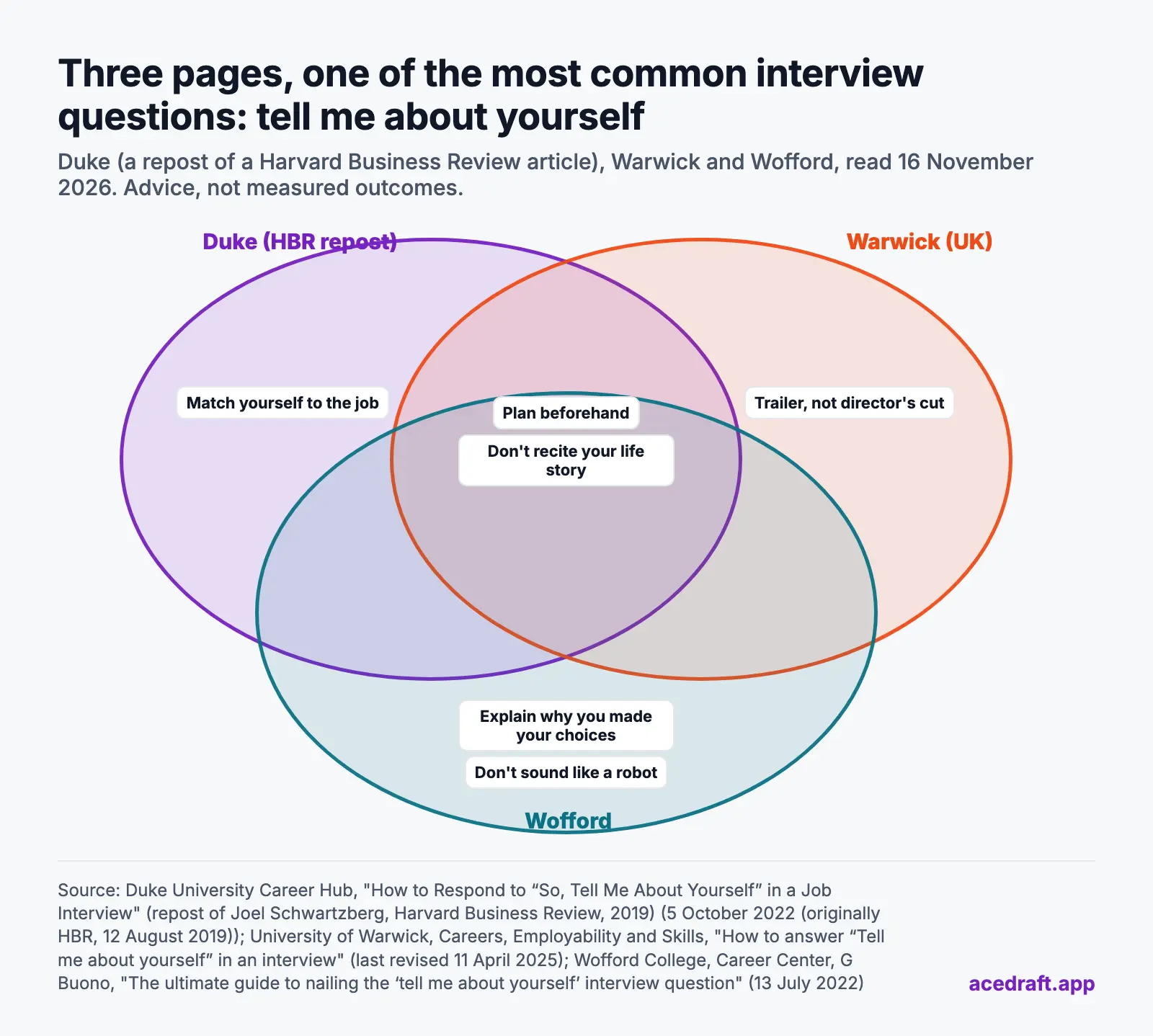
| Advice | Duke (HBR repost) | Warwick (UK) | Wofford |
| Plan beforehand | Yes | Yes | Not stated |
| Don't recite your life story | Yes | Yes | Not stated |
| Match yourself to the job | Yes | Not stated | Not stated |
| Trailer, not director's cut | Not stated | Yes | Not stated |
| Explain why you made your choices | Not stated | Not stated | Yes |
| Don't sound like a robot | Not stated | Not stated | Yes |
Sources: Duke University Career Hub, "How to Respond to “So, Tell Me About Yourself” in a Job Interview" (repost of Joel Schwartzberg, Harvard Business Review, 2019) (5 October 2022 (originally HBR, 12 August 2019)); University of Warwick, Careers, Employability and Skills, "How to answer “Tell me about yourself” in an interview" (last revised 11 April 2025); Wofford College, Career Center, G Buono, "The ultimate guide to nailing the ‘tell me about yourself’ interview question" (13 July 2022).
Here's how I'd put an answer together. The order is my own habit:
- Mark the posting. Highlight the phrases next to "required" and "must have", as Schwartzberg suggests.
- Pick two things you've done that match them. Real ones, that you can talk about for a few minutes if asked.
- Start with now. What you do today, or what you've just finished studying.
- Go back once. One earlier step, and why you took it. This is Wofford's point about decisions.
- Finish with why this job is the next step. That's the line that hands the conversation back.
- Say it out loud a few times, but don't memorise it word for word. A script you've memorised is how you end up sounding like the robot Wofford warns about.
Here's an example I wrote for this post, for a made-up graduate applying to a junior data analyst job. It isn't from a real interview:
I've just finished a degree in economics, and the part I enjoyed most was the data work, so for my final project I cleaned and analysed a council's bus usage records. I picked that project because I wanted to see whether I liked working with messy real data, and it turns out I do. Your posting asks for someone who's comfortable with SQL and explaining results to non-analysts, and those are the two things that project made me practise most. That's why this role is the one I wanted to apply for.
Notice what it leaves out: school, hobbies, the summer job that has nothing to do with data. All of it is fine to mention if asked. None of it helps this match.
Your resume summary is the written twin of this answer: the same pitch, a few lines long, at the top of the page. If you've written a good one, you've already done half the work. I covered that in resume summary examples and how to write your own.
How do I answer "why do you want to work here?"
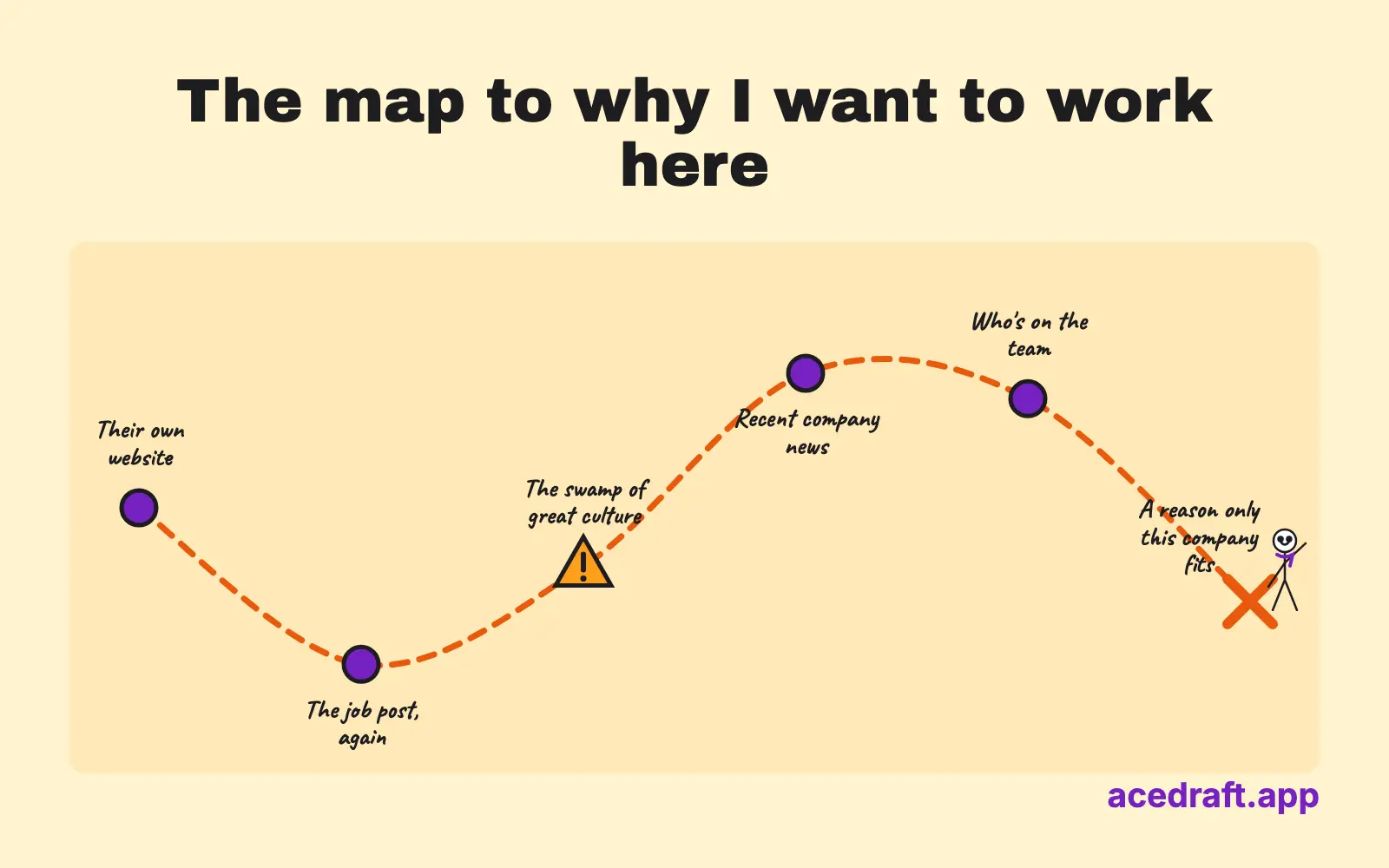
The answer that works names something you found out about this employer yourself, tied to something you want to do in the job. A reason that would fit any company tells them you haven't looked.
This is the question the company-research advice is really for. UMBC puts the expectation plainly: "The employer expects you to show knowledge of and interest in the company." BYU-Pathway says to "Research the company ahead of time to learn what they are passionate about." MCPHS says you "must" do it.
None of the three pages says where to look in the lines I recorded, so this part is mine. I'd check:
- The employer's own site, especially what they make and who they sell it to.
- The job posting again, for what the team is trying to do.
- Any recent news about the company, because "I saw you just opened an office in Pune" gives you far more to say than "you're a leader in your field".
- The company's LinkedIn page, for who's on the team you'd join.
Then join one of those findings to yourself. Take a made-up applicant to a made-up company that makes accounting software for small shops:
My parents run a small shop, and I've watched them do their accounts in a notebook for years, so software that makes that easier for people like them is work I'd care about. Your posting says the support team talks directly to shop owners, and that's the part of the job I'm most interested in.
The shop is the applicant's own reason, and the support team is the bit of this job it connects to. Nothing in it could be copied to the next interview without being rewritten, which is the point.
How do I answer "why should we hire you?"
This is the closing-argument version of "tell me about yourself": pick the things the job needs and give one real example of each, from your own work or study.
BYU-Pathway's advice fits it well: "Show them how you can help them meet their business goals." MCPHS says: "Point out your achievements, accomplishments, and applicable experience." Schwartzberg's line about matches, from the Duke repost, applies here too. They've seen the resume, so spend this answer on the match.
Same made-up support job:
You need someone who can explain accounting software to people who don't think in accounting terms, and that's what I did every weekend for two years at my parents' shop. I also set up their stock spreadsheet, so I'm used to working out what's broken from a vague description. I'd be able to start helping your customers quickly.
Your resume is where those matches start. If you want to see which words from the posting your resume already uses, I built a free ATS scan that compares your resume PDF with one pasted job description and lists the posting's keywords your resume has and the ones it's missing. It's AceDraft's own scoring, not any employer's system, and it checks the resume only. It won't help you rehearse an answer.
Where do you see yourself in five years?
I'd talk about the kind of work you want to be doing and what you'd like to have learned, rather than a job title you're aiming to take from someone in the room. UMBC has two lines that fit this question, though my notes don't record which question they sit under on the page: "The employer wants to know if you are ambitious, plan ahead and set goals for yourself."
The second gives you some room: "It’s acceptable to communicate you are considering several options as opposed to describing specific details." I find that a relief. A direction that makes this job a sensible step is enough. Nobody's asking for a five-year plan you'd sign in blood.
What do I say when they ask about my strengths and weaknesses?
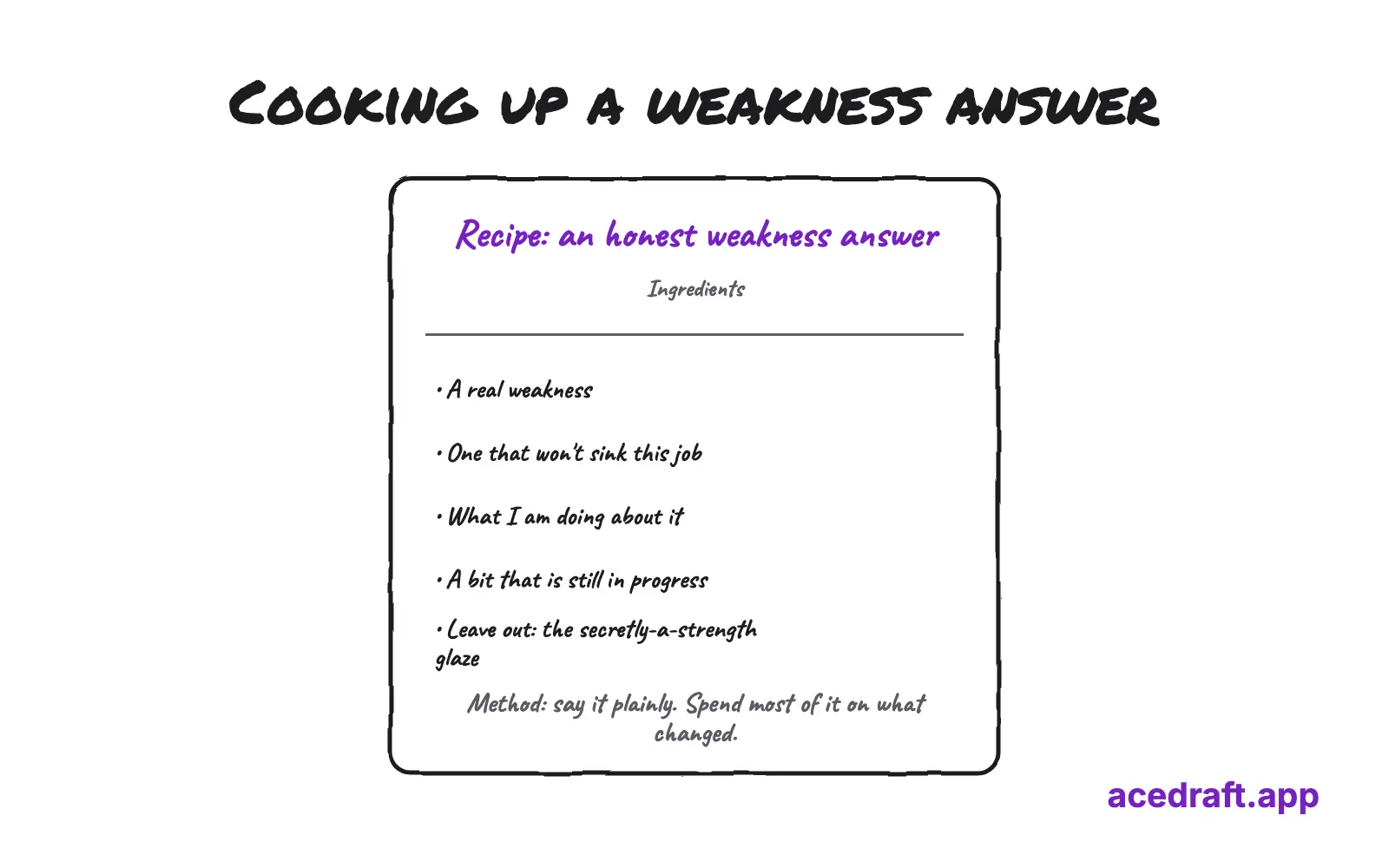
I'd pick one or two strengths this job needs and back each with a real example. For weaknesses, name a real one that won't get in the way of this job, and say what you're doing about it.
Strengths are the easier half. Two MCPHS lines fit here: "Try to be as specific as possible," and "Point out your achievements, accomplishments, and applicable experience." A strength with no example is just an adjective. "I'm organised" means nothing until you mention the rota you rebuilt, or the project you handed in early.
Weaknesses are where the six pages stop agreeing. Here is the split, as plainly as I can put it:
- BYU-Pathway says: "Highlight a weakness that can also be perceived as a strength." It also says: "Share what you are doing to improve on a weakness."
- MCPHS says: "Try to turn a negative into a positive."
- UMBC says to "Identify a weakness that will not significantly hinder you in the job for which you are interviewing." Then it warns: "The “I have a tendency to take on too much” weakness gets overused, and employers get tired of hearing it."
So two pages recommend a weakness that doubles as a strength, and the third warns that the best-known example of that move has been heard too often. UMBC doesn't ban the idea. It says the most popular version of it has stopped working.
Author's take. This is my opinion, not a finding. I'd skip the weakness-that's-secretly-a-strength answer altogether. It's the one the interviewer is most likely to have heard before, and it dodges the question they actually asked. I'd take UMBC's rule for choosing the weakness (real, but not central to this job) and BYU-Pathway's rule for the second half (say what you're doing about it). A real weakness with a real fix is more believable, and it gives the interviewer something to ask about.
A made-up example, for an office job where public speaking isn't part of the role:
I get nervous presenting to big groups. It isn't a big part of this job, but I don't want it holding me back, so last term I volunteered to present our group's work in two classes, and I've started writing a one-line point for each slide instead of a script. I'm still not relaxed about it, but I'm a lot clearer than I was.
Most of its words go on what changed, and it admits the fix isn't finished. I think that makes it more believable.
What I'd avoid, again my own view: a weakness that is the job. If you're interviewing to be an accountant, "I'm not great with detail" is honest and still the wrong answer to give. That's the case UMBC's "will not significantly hinder you" rule is there to catch.
How do I explain why I'm leaving, or a gap in my resume?
One honest, short reason is plenty, and then I'd move on to what you want next. None of the six pages covers either question, so this is only my own view: for leaving, say what you're looking for that your current job can't give you and don't criticise your employer; for a gap, say in one sentence what happened and what you kept up or learned, then move back to the job. I wrote more about the gap side in how to explain a career gap on a resume honestly, then show proof.
What should I say when they ask about salary expectations?
I'd give a range you've researched for this kind of job in this place, and say you're open to talking about the whole offer. None of the six pages I read covers salary, so that's only my view, and I'd keep the real negotiating for after an offer arrives. That part is in how to negotiate salary after a job offer.
What about the "tell me about a time" questions?
Those are behavioral questions, which ask you to describe a real past situation, and I've kept them out of this post on purpose because I've already written about them in detail: they're grouped by what each one tests in behavioral interview questions grouped by what they test, and how to shape an answer with the STAR method is in STAR method resume bullets and interview answers.
What should I ask at the end of the interview?
Ask about the job itself, like how success is judged or what the first month looks like. Never say you have none. BYU-Pathway is firm about this: "Even if you don’t have questions, ask questions."
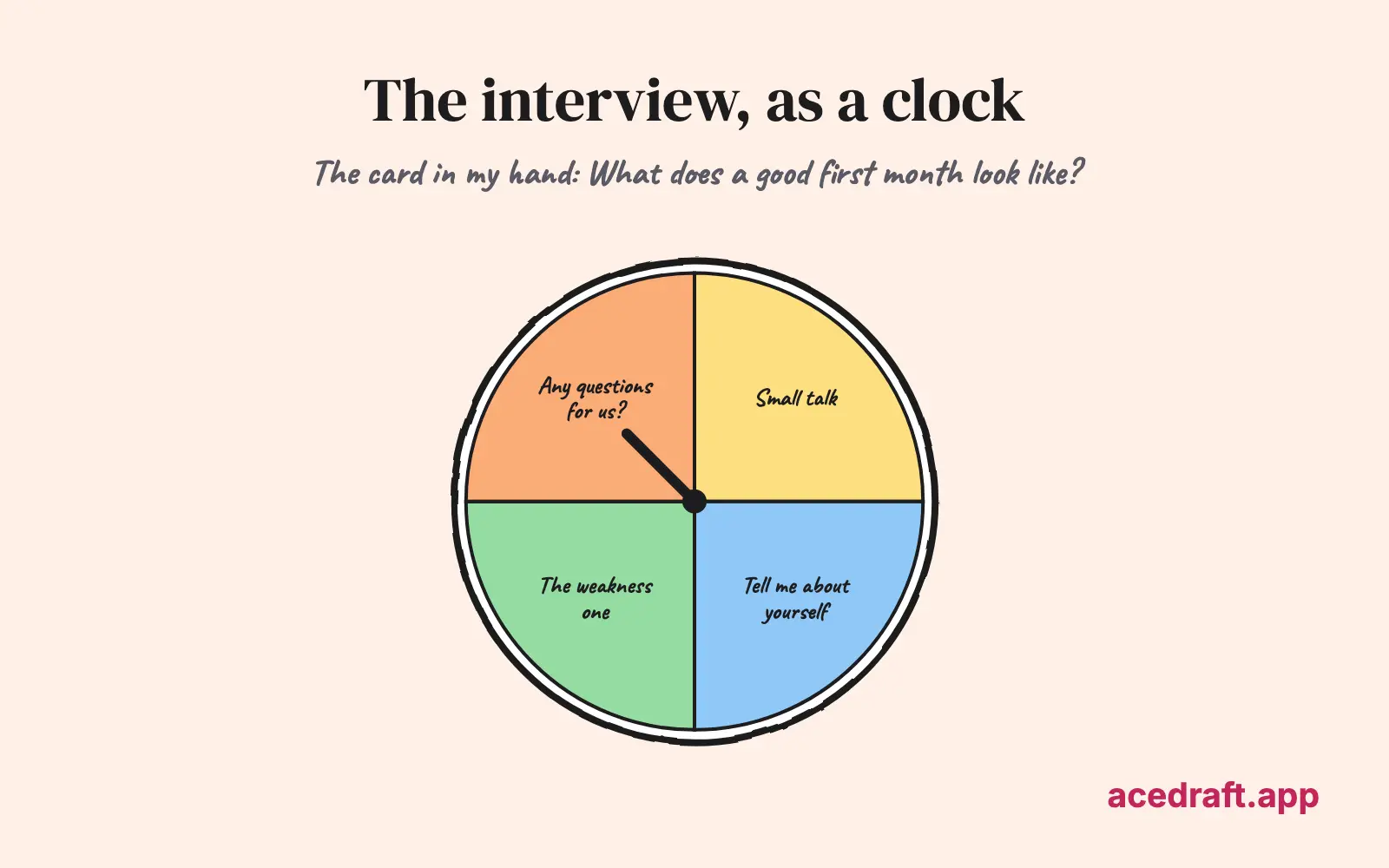
That last slice of the clock is the moment I'm trying to get you past. "Any questions for us?" sounds like the end of the interview, so it's easy to relax. It's also your last chance to show you've thought about the job, and a blank "No, I think you've covered everything" wastes it.
BYU-Pathway suggests going in with a lot: "Bring five or more thoughtful questions to ask about the position and/or the company." Five sounds like too many until you realise that some will get answered during the interview, and you need a few left over at the end.
It also gives an example question that I'd happily steal: "Can you tell me how success is measured in this position, department, and by the company?" It's a good one because the answer tells you what the job really is, which the posting doesn't always do.
Here are a few more. These are mine:
- What would a good first month in this job look like?
- What's the team working on right now that the new person would join?
- What do people who do well in this role tend to have in common?
- Is there anything about my background you'd like me to say more about?
The last one is a little brave. I'd still ask it, because it gives you one more chance to answer a doubt before you leave the room, and it's a doubt they'd have kept to themselves otherwise.
What I'd avoid: questions the company's own homepage answers. If you've done the research the three pages tell you to do, you won't need to ask what the company does, and asking would undo the effort.
What haven't I tested?
I haven't tested whether any of this advice changes how an interview goes, and none of the six sources measured that either. Here's what that leaves out:
- I didn't run a study of what interviewers prefer. I compared six public career pages, five in the US and one in the UK, and wrote down what each one says.
- I found no survey or statistic on common interview questions, so there isn't one in this post.
- None of the six pages covers salary, leaving a job or employment gaps. My advice on those is labelled as my own view, and it's only that.
- I have no Indian source, so I can't say whether an HR round in India differs from what these pages describe.
- Three of the pages (Duke, Warwick and Wofford) are about "tell me about yourself" only, so they say nothing about the other questions.
- Every example answer here is one I wrote for a made-up person. None comes from a real interview.
- Pages change. I recorded these lines on 16 November 2026, and three of the six show no date, so I can't tell when their advice was last reviewed.
I also haven't built an interview tool, so there's nothing for me to show you working. Everything in this post is preparation you do yourself, out loud, ideally in front of a friend who'll tell you when you've started sounding like a robot.
Use this if your interview is a general or HR round and you want an answer ready for each of the usual questions. Write a short answer to each one and check it against the posting. Then say them out loud until they sound like you. Learn the points and let the sentences change each time.
Skip this if your interview is mostly "tell me about a time" questions or a technical test. This post doesn't cover them; the behavioral questions post does. Skip it too if you need sourced salary or gap advice, because none of my six sources gives any.
Sources
- Duke University Career Hub, "How to Respond to “So, Tell Me About Yourself” in a Job Interview", a repost of Joel Schwartzberg's Harvard Business Review article (originally 12 August 2019). Reposted 5 October 2022; I read it on 16 November 2026.
- University of Warwick, Careers, Employability and Skills, "How to answer “Tell me about yourself” in an interview". Last revised 11 April 2025; I read it on 16 November 2026.
- Wofford College Career Center, G Buono, "The ultimate guide to nailing the ‘tell me about yourself’ interview question". Dated 13 July 2022; I read it on 16 November 2026.
- UMBC Career Center, "Responding to Challenging Questions". The page shows no date; I read it on 16 November 2026.
- BYU-Pathway Worldwide, Career Services, "Preparing for Interview Questions". The page shows no date; I read it on 16 November 2026.
- MCPHS University, Career Development Center, "Interview Questions Everyone Should Expect". The page shows no date; I read it on 16 November 2026.
Frequently asked questions
What are the most common interview questions?
How do I answer tell me about yourself?
How do I answer why should we hire you?
What should I say when they ask what are your weaknesses?
Is it bad to say I have no questions at the end of an interview?
Are HR interview questions different from common interview questions?
Does AceDraft help me prepare for interviews?
Is the AceDraft resume export free?
Share this post
Know someone job-hunting? Send it their way.
Comments
No comments yet. Be the first to comment.